I think the server CPU area will be more immediately interesting. What's interesting this time, vs Opteron, is that AMD doesn't need to convince a bunch of conservative data center managers.
A few key wins with the three cloud giants, and Intel will feel it. And the cloud giants can start with things like managed messaging, databases, etc, where it's not directly exposed to end users. Similar for the various high end AARCH64 CPUs. Intel is in for a ride.
Except this hasn't happened. If anything Intel is still selling as many as they could produce as shown in the latest quarterly report [1]. So while AMD managed to grow double digit over a very small number, it still felt they were picking up the scraps from Intel.
And Amazon is full steam ahead with their own ARM CPU. I wonder if Google and Microsoft paused and think they will need to act now if they haven't already.
Even in the consumer range, the Ryzen 5-9 parts are crazy value as well when building a reasonably future-proof computer. I am building a 3900x computer now, and with screen and peripherals it will end up sub 3k (this is Swedish prices, so it is quite a bit more expensive than in the US).
More advice: don't get carried away with liquid cooling solutions - they will always leak eventually, and if the pump fails your CPU instantly fries.
Just get the biggest honking Noctua fan+heatsink you can fit in your case and call it good. It's silent, simple, reliable, and if the fan does fail the heatsink will save your CPU.
This is completely anecdotal of course but for the 8 years I've been running watercooled PCs (admittedly professionally built), I never had a leak. Or a pump fail for that matter, but even if one did fail, the CPU will shut off.
Furthermore, you are supposed to use distilled water or non-water based coolants with high electric resistance.
Shameless plug but I’ve built a bunch of water cooled computers and even the more reliable ones like the Swiftech build below with John Guest push fits (rated for 25 years use) do eventually leak.
Regarding distilled water, it is indeed not very conductive at all but it is also quite reactive and if it touches electrical traces and PCBs starts to leach ions from the surrounding until it starts to conduct at which point the machine will short circuit (speaking from first hand experience alas).
I've been running a big ass noctua on my 5930K (first intel 6 core) for a solid 6 years now on a 4.2GHz overclock. No problems whatsoever, other than the thing doesn't want to do 4.3 anymore, but it was always a bit unstable when i was running at that speed. I'm sure I'll update soon though.
I did this for my 3950x, and it works well. The temps on the CPU still spike up quickly and generate a bit of fan noise under brief loads, but apparently that's quite standard for this platform.
Are you happy with the 3950x? I’m looking at the 3950x and 3900x. I’m not sure if the extra $250 is worth it. It’s replacing a i7-7700k so either one will be a nice upgrade.
There’s a base clock frequency drop that comes with the higher core 3950X that I don’t think is worth it for the prosumer, unless you really do a lot of multitasking.
Both the base clock and max turbo clock are never reached with my Ryzen 3950X. It tends to run at about 4450 MHz single core and 4020-4220 MHz all cores. Mainboard is the marginally suitable Asus Prime B350-Plus, cooler Thermalright Macho Direct (for height reasons).
Virtualization, 4K Plex Transcoding, and other Video Transcoding. It would also serve as a home Flask api that will save data collected by various Raspberry PIs and thermostats. All purpose Linux home server box.
For the closed loop systems (4) I've been using for nearly a decade I haven't encountered any leaks. knocks on wood I've only had a fan die after 3-4 years of 24/7 use.
In theory. I've heard many unscientific anecdotes of CPUs being killed this way. My understanding is that in a liquid cooling system without flow, or with no cooling system attached at all, delta-temp over delta-t is so high that the thermal cutoff circuits might not react fast enough before other parts of the chip have been damaged - especially if the chip is under load at the moment of failure.
On the other hand, a heatsink provides a decent amount of passive cooling all by itself, so when the fan fails there's a buffer that slows the rate of heating to a safe margin.
That is incorrect, the thermal protection circuits operate well in advance of the actual junction death temperature. Usually 20C or so minimum on mobile and more on Desktop. The CPU will throttle like mad first to save itself and then just reset the computer assuming the BIOS doesn't block the boot in the first place.
My TR4 II 360 OC AIO's pump failed recently; it took about 1 hour of intense Deep Learning training to reach 100 degrees at which point the motherboard shut down. I was dumbfounded about what was happening, then after ruling out Titan RTX, power supply etc. problems I noticed a slow climb of CPU temperature. AIO manufacturer didn't even ask for anything and sent a replacement right away and computer is happily number crunching again.
My be quiet heat sink is giant and came with two fans. And I have the ability to add a third.
If one of the two fans fail i’d guess temps may raise a few degrees and that’s it. I could even manually test it with one fan and light loads to check one fan performance.
Modern CPUs adjust to their level of cooling. They don't 'burn up' even if there is no heat sink at all. What you are saying sounds like it is either fear based hyperbole, rumors from over 20 years ago, or both.
I agree with you that a properly designed CPU shouldn't instantly fry for lack of cooling but is water cooling really worth it? As far as I can tell outside of very esoteric special-purpose equipment it seem very uncommon in the professional world and seems mostly popular with g4m3rs looking to impress their peers with their $10k gaming PC builds.
In my experience air cooling with a sufficiently large heatsink is simple and very reliable. Water cooling is more expensive, trickier and can fail catastrophically.
I use the AIO water cooler on my home system because I can get the system essentially silent (0.5m from my ears) at reasonable temps. They are also a lot less fiddily to deal with (install, ram access, etc...) compared to the huge air cooler you would need for comparable performance IMO.
All in One (AIO) also known as a closed loop cooler for the uninitiated. They're water coolers that come in a single pre-built piece that you just attach like any fan.
Source: Been rocking Corsair AIO coolers for around a decade now. I did have have the pump fail in one of them after around seven years of use.
Is not about cooling performance but noise reduction. You need fewer fans and can use bigger ones (= less RPM) giving you a double whammy of noise reduction.
Perhaps if you don't forget to activate the BIOS CPU warning at high temp, you shouldn't worry about this .
I recently fixed a PC where the pump died without anyone noticed, and the only evidence, was that the BIOS was powering off the computer when the CPU gets too hot.
I have been using these big honking Noctua coolers for my last two build. They are truly completely silent when idle. You have to put your head directly next to the case to hear them at all when you're just browsing or doing light tasks. And they only give a reasonable amount of clean fan noise when running max. No squeaking or annoying peaking frequencies.
Coupled with high quality power supplies that are also virtually silent, this makes for dream PCs.
Seconding this recommendation, though for slightly different reasons. When I first built my current home workstation (with a Threadripper 1950X) I built it with one of those Enermax liquid coolers, which worked great for a few months until it stopped actually wicking away heat. Turns out there's some sort of corrosion that totally kills the insides of the cooler, and it was a common problem for that particular cooler.
Bought the thiccest Noctua I could find on Amazon and haven't looked back.
I've got a custom loop with my Ryzen system (420 + 280 rads, mostly EK kit including a D5 Glass XRes) and it's been enjoyable putting it together, and if you're not totally incompetent easy enough to make leak-free with the latest generation of fittings.
As for a pump failing, as others have said the CPU will thermally throttle before damage is done, but for added peace of mind I'm running my setup with an Aquaero which will shut the computer down if the coolant temp breaches a set threshold, or it senses the pump has failed.
The biggest thing for me is that my computer is EERILY quiet unless I'm pegging all 8 cores, and the GPU, at 100% ... which makes for a nice peaceful environment.
Thank you for this advice! I’ll have build with 3950X in close future and was keen on installing liquid cooling solution. But now I’ll end with classic fan+heatsink for longevity. Current system is an old FX-8350.
CPUs are supposed to throttle before thermal damage. I don't think I've ever seen a report of an actual CPU failures due to cooling failure.
Also, FWIW: integrated liquid cooling solutions are if anything simpler and more reliable devices than fans: smaller motors running at lower RPM last longer.
My current system was water cooled and the pump failed. My mobo kept shutting the system down before I figured out what was happening. It took more than few bios reboots to figure out it failed. The CPU is fine and has been on a cheap fan cooler for over a year.
I feel it's safe to assume that any enthusiast building his own system with high end parts won't be using the stock cooler which I feel needlessly increases the cost of the product that's passed on to us for something that will end up in the seller.
Although you can buy the CPUs in TRAY format without the cooler, the prices are almost identical to the BOXED version and your warranty is lower since they're designed to be sold to businesses not consumers.
The stock coolers on Ryzen processors are reallyreally good compared to Intel stock coolers. Maybe not so great for a 3900x, but they'll even support light overclocking on most of the other Ryzen options.
I was under this assumption, but I bought a 3600 which comes with the "Wraith Stealth" or similar. The cooler is nearly identical to Intel's crap stock coolers and can't keep up with the CPU under load (as in, at all) and with the fan at 50% at near idle, the CPU runs 40 degrees C
>can't keep up with the CPU under load (as in, at all)
I think this is exaggeration. I have 3600 with stock cooler and at full load clocks doesn't seem to fall below 3.8GHz, 86°C (well, I tested on linux make -j12, maybe on some AVX loads it is worse).
Playing rainbow six siege would push the temp to 92 degrees within a minute of 3d rendering. It still is running at about 3.7-3.8ghz, but I don't want it to be that hot. IIRC, running cpu-z stress test also mostly just hit under 90 degrees. It also idles at 40 degrees, despite my apartment being 65 degrees F.
Funnily enough, siege has recently released a vulkan based build that runs at a cool 74 degrees.
The wraith stealth is just an incredibly anemic and disappointing heat sink. It's "functional"but only at average loads. This is in comparison to the previous generation's cooler for the midrange CPUs that was about twice as large. It's not a deal breaker, my 3600 is still miles above anything I've ever run previously, and it isn't dying under the heat, but it might just run one year less than it was initially designed for at those temperatures
The reputation originally came from the original Wraith (now Wraith Spire) that you get with the 3600x (the main value add for the X model), the 3700x and 3800x. The Wraith Prism was also apparently pretty good in its first outing on the 2700x, but apparently the 3900x/3950x are a bit much for it to handle gracefully.
To the point where I question the legitimacy of including stock coolers with such demanding processors.
My own Wraith Prism is just sitting in the basement, and I don't see myself ever using it, unless something happens to my high-end cooling system and I need to install something while getting it fixed, at which point it'll go back to the basement again.
It would be interesting to see statistics on how many Wraith Prism coolers sold together with 3900X CPU:s actually end up being used. I expect the number to be quite low.
The first gen of Ryzen 7 chips didn't even include a cooler. I suspect they throw in the cools just so reviewers don't put "no cooler included" in the cons section of reviews.
I'd expect it to be pretty high: given reviews, I went with the stock Wraith Prism, and it's been fine. If I did bump up, I'd go to a Noctua, as the water cooling just seems like theater. https://www.youtube.com/watch?v=23vjWtUpItk
It can, just fine. A better cooler keeps it cooler, and you might get an extra 0.1 mhz from it. With the Prism, if you have had/having trouble with it keep in mind two things:
1. there is a switch on it for a higher or lower fan setting
2. you have to crank that little lever HARD all the way over to properly clamp it down. Lot of people miss that.
It can handle itself in the sense that CPU won't overheat or spend its entire time throttled.
It can't handle it in the sense that it's very loud in doing so, and the CPU will boost more with a better cooler, even with no other changes.
I bought a 3900x and planned to use the stock cooler initially, but that lasted about 3 weeks before I replaced it due to noise primarily (I got a be quiet dark rock pro 4).
I think a after market cooler is always going to be better, but I think it's disingenuous to state it can't handle it. In your specific case it handled it fine but was loud.
IMHO it crosses the line from "loud" to something unacceptable enough to call broken.
At idle with default fan curves, it was on the knife-edge of max-speed not just loud but continuously revving up and down so incredibly distracting. It would continually grab my attention even with headphones on.
I barely lasted a day before ordering a Dark Pro 4 and now it's silent.
Do people just leave the side of their case off or something. At 100% it's definitely not loud unless I remove the side panel off my case. It makes a noise for sure, but everyone makes it sound like it's the end of the world noise.
A friend of mine recently asked if my PC is okay in a very worried tone, I said that’s how I build a PC and he now makes remarks of his annoyance every time the afterburner kicks in, all while it’s just a cruise flight to me.
I have a NZXT H700i. Now if I compare my friends pc in the same tower with a after market cooler. When he turns it on I had to double check I pressed power cos it was silent. In mine. I hear a tiny noise. When at full speed. I can hear it. But it isn’t loud. In fact my old AIO was louder. So I definitely know what a good quality silent cooler is like. And I’ll upgrade soon just so it runs cooler than the stock one. But I just can’t understand the loudness thing.
I have the revving up and down issue on all MSI B450 boards (as do many others) with any cooler unless I set an unreasonably flat fan curve or just peg it at a fixed percentage. The only difference with the high end coolers is their effective speed is slower and quieter so it's barely noticeable.
I have been feeling like there's an issue with the board/BIOS/AGESA's PID control algorithm.
For what it's worth, my cooler settings were broken with MSI B450 BIOSes (I've got a Mortar) from the point they shrunk the code (with the new UI) to make room for Zen 2. But the last BIOS with the old UI is perfectly fine
How is the stability of the system? I always afraid of AMD because of their low investments into software that AMD systems won't be rock stable. Especially with Linux, where Intel commits a lot of code into kernel.
But AMD value is tremendeous, especially comparing with Intel CPU supporting ECC. I'm thinking about buying Xeon W-2265 workstation and it's just 12 cores for $1200, AMD is much cheaper and for that price I can get Threadripper monster.
>I always afraid of AMD because of their low investments into software that AMD systems won't be rock stable. Especially with Linux, where Intel commits a lot of code into kernel
AMD CPUs are used on servers so there is no reason they won't make all it's possible to have a stable system, are you referring to AMD GPUs? I read it takes up to 1 year after release until the graphics driver gets stable on Linux.
Ryzen 1st-gen had the segfault issue, RNG issue, voltage/clock related ones and few more. RX480 and 580 were exact same chips, only the latter was mature manufacturing wise and had completely different firmware resulting in a superior performance.
It’s true that AMD products has yield(as anyone else) as well as parameter tuning/compatibility issues especially early on. I don’t think their issues are of reliability kinds(like early failure in industrial Intel Atom) though.
I thought it was some valid concern for those who lived though the K5 /K6 / Athlon era.
I never had, or even heard of stability problem with AMD's CPU Core, but during the early days AMD surely had worse chipset especially in I/Os. Where it had compatibility or performance issues. But these days most of them are third party IPs, from USB Controller to PCI-E Express, and they are the same IPs used by millions if not billions on Smartphone, Tablet and many other use cases. So you can be sure they are pretty damn well tested.
I used to work at a global financial services firm that was AMD only back in the late 2000's when they were on top in the CPU wars. We never had any negative consequences from making that decision.
FWIW I used a 1st Gen Ryzen at home and it would constantly BSOD under Windows but ran completely stable with linux (this was when Ryzen was brand new)
1st gen Ryzen had some suboptimal values in some very internal parameter that caused incorrect DRAM reads affecting all OS. They accepted warranty claims and later released BIOS updates.
I doubt ECC would help prevent it(other than maybe by being slower?)
Maybe we will see that Moores law still holds (somewhat) true and it was Intels de-facto monopoly and their inability for progress to declare the end of Moore?
Very perceptive. Moore’s Law has been holding strong in the mobile/embedded market (ARM), on GPUs, and on neural processing units (TPP & cetera). The death di Moore’s Law was premature fratricide courtesy of it’s brother Intel (both being offspring of Moore himself).
CPUs keep on getting more memory channels per socket. That trend was already visible 15 years ago, when AMD moved the northbridge onto the CPU. Scaling it depends on scaling pin counts, which are now amazing.
In 2005, Opterons used a 940-pin socket and had dual-channel DDR, for 6.4GB/s total bandwidth to feed two cores. In 2009, Xeons the LGA1366 socket to provide triple-channel DDR3, 32GB/s for four (later six) cores.
Now, we're up to 4094 pin sockets providing 8 channels of DDR4 for a total of 204.8GB/s of memory bandwidth for 64 cores, which is exactly the same per-core bandwidth we had in 2005.
(And for comparison, a $200 graphics card will also have around 200GB/s of memory bandwidth.)
> which is exactly the same per-core bandwidth we had in 2005.
Modern CPU cores are way faster than ones in 15 years old CPUs.
That 2015 processor has AMD K8 cores. I wasn’t able to find exact info, but slightly newer AMD K10 can do 8 single-precision FLOPs/cycle, at 2.8 GHz.
Modern Zen2 cores can do 32 FLOPs/cycle at approximately same frequency, i.e. per-core performance improved by a factor of 4.
Both numbers are theoretical limits only achieved with very specific workloads and heavy use of manual vectorization. Still, real-life general-purpose code scales quite similarly between them. CPU benchmark says their single-threaded performance improved by a factor of 3.5.
Memory latency was in the 10 ns ballpark 20 years ago and still is. This is unlikely to change unless memory is migrated to an entirely different physical storage mechanism.
It takes light 1 ns to travel 30 cm (i.e. 1 standard body part / foot). So getting much faster must mean getting closer. I reckon it is only feasible if the RAM crawls into the CPU.
From A Certain Point Of View™, this is what the RPi and SO-PINE compute modules are, except unfortunately they're no longer usable as memory modules per se.
At this point I wonder why arent CPU vendors experimenting with memory compression. Works great in GPUs. This would have a chance of cutting latency if decompressing a cache line is faster than loading whole thing from ram.
Texture compression works because GPUs are bandwidth-limited in regards to memory. It doesn't really help you when you are latency-limited, because the latency-to-first-byte is the same or slightly larger for compression.
You arent always interested in first byte, besides CPUs operate on whole cache lines. Doesnt matter where the byte is, you will have to wait whole load anyway. We already have memory encryption.
"AMD mentioned a latency increase of 7-8 ns when memory encryption is enabled, which results in a 1.5% performance hit in SPECInt"
Here we would be compensating with smaller data transfers. Wouldnt have to be an amazing algorithm, even RLE would probably give latency improvements.
So at the consumer level, DDR2[popular standard c. 2005] could be clocked up to 266 MHz whereas DDR4[popular now] clocks in at 1600MHz. So a little more than a 6x speedup in transaction times. Unlike processors, whose features make it quite difficult to compare against each other, DRAM has stayed relatively straightforward: its still just a bunch of densely packed flip-flops connected to a memory controller that offers bank-strided column/row access.
As you can imagine, processor performance has grown a lot more than 6x over the years. The amount of cores in a package alone has increased more than 6x! So how do we get around this?
1) Larger caches: the most efficient optimization to any slow task is to simply not perform said task. Having a larger L3 cache means sending requesting fewer pages from DRAM.
2) “Hiding” latency with bandwidth: if I have to incur a (relatively) large time penalty tp go to DRAM, I better make sure to make it worth my time. Instead of always getting data in 4KiB pages, often times modern processors support “superpages” all the way up to the gigabytes. If you’re going to go drive out to the store, it makes sense to buy groceries for the week instead of just the candy bar you’re craving right now, right? That way when you actually have to cook the work has already been done.
I am probably missing some nuance here, especially when it comes to memory controllers and putting caches on DRAM, but this is the gist.
But frequency of RAM and latency is not the same. DDR2-800 can have something like 4-4-4-12 timings, while DDR4-2666 can have something like 15-17-17-35 timings. So their result latency will be around the same! And those numbers I just googled, I did not made them up.
DDR2 vs DDR4 has effectively zero impact on latency. Due to the physical distances between RAM modules and the CPU, that’s been stuck within a narrow range for decades. https://en.wikipedia.org/wiki/CAS_latency
The specific implication details make a difference, but nothing is going to provide a 4x improvement in latency so other considerations take precedence. The real change is ever growing cache sizes allowing CPU’s to minimize random RAM reads.
The memory controller referenced in CAS is in the CPU and the ram modules are part of those ram sticks so it’s not the only component of CAS latency but it is a big one.
“For a completely unknown memory access (AKA Random access), the relevant latency is the time to close any open row, plus the time to open the desired row, followed by the CAS latency to read data from it. Due to spatial locality, however, it is common to access several words in the same row. In this case, the CAS latency alone determines the elapsed time.”
No, distance from memory controller is NOT a component of CAS. CAS is the time it takes for row amps to stabilize their levels after being connected to selected memory cells (capacitors).
CAS is counted in clock cycles. Have you ever heard of a motherboard where you would have to add/subtract CAS cycles from memory module specification because of memory slot layout? ;-)
btw 10cm of track on pcb is about 2 clock cycles at 3GHz, ~0.6ns. Now you will love this one - in the last 20 years we went from ~15ns CAS down to ... 7ns, twice as fast! Even better - we got down to 7ns in 2006 https://www.newegg.com/g-skill-2gb-240-pin-ddr2-sdram/p/N82E... and stayed there for the last 14 years.
What we got instead is higher density and susceptibility to rowhammer.
CAS is the full round trip time, the controller does not care about individual components of the latency just the total latency. End users just see the CAS number, but what it’s repressing under the hood is not simply what’s going on inside a DIMM, which is why the numbers get higher with higher memory clock speeds.
Further, MB traces are just part of the story. It’s the physical distance traveled from a CPU’s memory controller to the furthest physical cell location on a chip which is significantly more than 10cm and it’s a round trip timing. Even just the physical DIMM’s are 13 CM wide.
A more accurate ~25 cm each way = 50 cm total ~= 3ns out of 6.56ns timing for a DDR3-2133 & CAS 7 ~47%. CAS 18 DDR4-4600 is 7.82 ns or ~40%.
PS: As to progress, DDR2-1066 at CAS 4 was 7.5n where CAS 18 DDR4-4600 is 7.82 ns that’s some progress.
2005 Intel server memory controller datasheet states up to 800mils for die to BGA ball distance (huge chip), thats 2cm. Newer stuff is hard to dig up. Afaik JEDEC DDR3/4 layout guidelines state no more than 4.5 inches to DIMM socket, 5 inches ball to ball. Max connector to ball length for DDR4 UDIMM is ~3cm. All in all max ~17cm.
Actually yes, the cache hit ratio is not linear with cache size so you get diminishing returns. http://www.dataram.com/blog/?p=112. On top of this, once a CPU core is operating at say 80% of the time the maximum possible speed up from more cache is 20%.
Further, every layer of cache adds latency and cost as you need to check it before going to main memory. In the 486 and early pentium days External Cache was common, but it’s no longer useful.
I had something more like a swap than a cache in mind. Expose it as additional physical address space and let the OS decide which pages live there vs main memory.
Yes. The very same reason why they waited years before they eventually moved the memory controller on to the CPU die.
It's expensive m2 real estate and eats a big chunk of the waffer.
Furthermore, there is diminishing returns regarding all kinds of cache. Most of the recent performance increases are attributed to the very dangerous practice called branche prediction.
> Instead of always getting data in 4KiB pages, often times modern processors support “superpages” all the way up to the gigabytes.
Page size is irrelevant for purposes of getting data from RAM to CPU / cache. This is done by cacheline size, which is usually 64 B. Higher page size helps with better TLB efficiency and also for disk to RAM copy (if that is strictly page-based).
Update: I was wrong about pages, but the fundamental notion that we're moving towards "solving" latency issues with bandwidth hasn't changed. Paging strategies don't change CAS timing (which is what I should have replied with), but your CAS timings are only half of the equation, hence my emphasis on bandwidth.
The rule of thumb is 25GB/s per channel. At 8 channels you have 200GB/s. Unless you are working with SIMD it is unlikely that you actually hit these numbers.
Actually it's super easy, barely an inconvenience, since the raw memory bandwidth you get per core is around 1 byte per cycle and half that per thread. A 3900X with 12 cores / 24 threads getting a total memory bandwidth of 57.6 GB/s (using DDR4-3600) has just 0.6 bytes / cycle and thread. Meanwhile the CPU can actually achieve ALU throughputs that are 20 times greater than that. Even encryption algorithms are much faster than that.
The saving grace is not that there is a lot of memory bandwidth to go around; there isn't; the saving grace is that a lot of processing either doesn't use too much data (making caches effective) or is complex enough to not be limited by memory bandwidth. Rarely using all cores and threads at the same time helps a lot as well.
> Actually it's super easy, barely an inconvenience
Wow wow wow.
Your references are TIGHT.
----------
The main RAM / CPU issue is latency: it takes over 100-clock cycles to communicate with DDR4, which a CPU could process ~400 instructions if they were lined up just right (modern CPUs are super-scalar, executing multiple instructions per clock tick).
Only once you have sizable caches + data locality will you solve the latency problem.
Without locality, I'm not sure if the latency problem can be solved at all. Fortunately, many problems have an element of locality that can be taken advantage of.
Memory controllers do prefetching for streaming memory accesses. Yes a lot of workloads are more latency sensitive, but it's not like sequential streaming memory accesses are hard given the prefetching.
(Anyone have pointers to current EPYC vs Xeon STREAM results?)
That might be what the parent is saying. Most software is so poorly written that even if it needs to do something CPU intensive it is probably still skipping around in memory so much that memory bandwidth isn't an issue.
My experience is that it takes well structured memory access to actually max out memory bandwidth even if the numbers seem like the CPU would be starved.
I’m interested in this as well. As opposed to CPUs from 15 years ago, the 3990X has 256 MB L3 cache and around 100 GB/s of memory bandwidth, which should help a bit. What kinds of workloads can we expect to be bandwidth-botllenecked still?
If a program is structured in a particular way to run through large spans of contiguous memory but only do trivial operations, then memory bandwidth can be maxed out by the prefetcher and the cache wouldn't be used.
Things like adding two huge images with SIMD and writing out a new image could be like this. It would be much better of course if the image is tiled and more operations are done per tile, which would use the cache.
Good use of the prefetcher but poor use of the cache could still run through memory bandwdith.
It has a separate dedicated IO die, allowing memory access/latency to all cores. I think threadripper does have less bandwidth than the 64 core Epyc part though.
Indeed as TR is 4-channel and Epyc is 8-channel. If one needs ECC, TR is a bit more limited still due to unbuffered ECC memory having lower max speeds presently.
Just heard that VMware is changing the license for vSphere up to 32 cores and you have to pay more expensive license if your using more than 32 cores per CPU. In my opinion VMware products are overated there are good enough free to use products similar to vShpere without the per CPU/socket licenses with payed support if you need one.
Nitpick: IBM beat VMware by some decades at "first useful virtualization software".
The VMware thing was that they figured out how to make virtualization on i386 compatible hardware hobble along despite the hardware architecture being technically unvirtualizable, using clever binary translation style tricks. Virtualization support came to x86 hardware many years later.
> I don't know if there are enterprise-supported Xen distros.
Didn't Citrix buy xen a while back (or some part of it)? They had something called xenapp, now apparently "Citrix Virtual Apps and Desktops (XenApp & XenDesktop)"?
Not really the same as "a supported xen distro" I guess.
I didn't specifically measure that, but most builds are limited by Amdahl's law (./configure kills you) and there will rarely be 256 compiles that can happen in parallel at any one time.
This is great but why is it so difficult for AMD to break into the enterprise/server side of the market? Seems Intel is very entrenched in that space despite their clear exercise of market power for over a decade.
For big companies, migration to AMD is a risky move. Old applications work well on Intel and Intel has been reliable for years. Big corps love boring tech. Now that Intel offering sucks, they do notice but they are not jumping all the the same time. Will the old applications work well on the new AMD tech? What if there is an incompatibility/HW bug on AMD platform which makes critical applications fail?
It takes years for the big companies to get interested in such a big of a platform switch. For now, they've been sticking with Intel and observing how the situation develops. If Intel keeps screwing up, which they do, eventually the big migration will happen.
I said before - it's more than just this. AMD's ecosystem just sucks... Intel may be doing things that are questionable, but, as a OEM on the much smaller size, Intel have a great partner program.
With Intel, I get advanced warranties, presales support, next day parts, details marketing and product information alongside access to privileged information and roadmaps.
With AMD, I was waiting the best part of 3 months for a call back, and their "partner" site which is open to the world is severely out of date and doesn't even have all products listed.
Intel is frictionless when it comes to doing business, AMD put up roadblocks.
This is my understanding as well. And why I believe AMD needs to either merge or be acquired to really make a run at CPU/GPU market. They’re seriously underperforming (this isn’t to say Lisa Su is a bad CEO).
Can anyone vouch for how well consumer CPUs have come along in the last 5-10 years?
I'm still running a i7 2700k and haven't even felt the need to upgrade. I guess i didn't want to when Intel only released $600-$800 scam CPUs, now were seeing reasonable competition is it worth another look?
I run a meta benchmark[0] that is set up to answer exactly questions this this. The answer: Processors made a big jump since then! There was not that much movement after the 2600K, but only until Ryzen got released. The 2600K is now on rank 86 of my benchmark, way below $120 cpus like the Ryzen 5 2600 [1]. That comparison just shows games, but in in other application workloads the difference is even bigger, because of the better multithreaded performance of Ryzen and Threadripper processors. The 3970X just completely dominates outside of games, but with the Ryzen 9s there are two cheaper and still extremely strong processor for consumer AM4 systems available. And Intel has way stronger processors than the 2600K now as well, the complete 9000 series staring with the i5-9400F ($140). Stronger cores and more of them, i5s have six now, the i7-9700K 8 and the i9-9900K adds hyperthreading.
The comparison (https://www.pc-kombo.com/us/benchmark/games/cpu/compare?ids%...) shows that the Ryzen 5 2600 (late 2018) barely manages to outdo the i7-2600K (early 2013) since the compound score difference is 7.54 - 6.16 = 1.38. Plus the gaming benchmarks that the Ryzen dominate are mildly misleading since all the games run above 60fps so average gamer will be fine, i.e. Witcher 3 comes in at 133fps on the i7-2600K and clocks 200fps on the Ryzen. Of course processors HAVE become massively faster but the question remains whether one has a workload that's sufficiently parallelizable to warrant the upgrade. Individual core speed improvements are still lacking.
The compound score is really just a rating. It does not reflect performance that way. You really want to look at the individual gaming benchmarks for this.
There are many gamers using 144Hz displays now, so 60 FPS is just one of multiple possible targets :) Witcher 3 is also really not the heaviest of games.
> Of course processors HAVE become massively faster but the question remains whether one has a workload that's sufficiently parallelizable to warrant the upgrade.
Well, sure. But all common workloads are parallelizable now. Whether it's games or running your browser, the time of strictly single threaded workloads is over.
> Individual core speed improvements are still lacking.
Interestingly, that really depends on your definition, of what one expects. The difference in single threaded workloads is smaller than in multithreaded workloads - obviously, there are more cores - but the cores are also ~30% faster in this case, and Ryzen 3000 got another round of singlethread performance improvements. For example https://www.computerbase.de/2019-07/amd-ryzen-3200g-3400g-te... shows that, a benchmark of single core application workloads.
Yeah, you are right, especially in relation to the single core speed which I must admit I just had not looked into enough when writing my response. Had a look at https://www.cpubenchmark.net/singleThread.html which confirms computerbase.de article exceedingly well in terms of the much improved single core perf across the Intel/AMD divide over last 5 yrs.
This is great, thanks. One of my biggest issues in PC hardware has been comparing older parts with modern ones. Most sites don't retest old hardware with new tests that they use on new hardware, so you end up with wildly different numbers that don't tell you anything.
Thanks, and exactly! It's an interesting algorithmic problem to get many of those separate benchmarks and put them into a global order. That's what the site does.
As entirely anecdotal evidence, I upgraded from a 2500k (that I'd been running at 4.5GHz) to a 3600 and the perceived difference in speed is phenomenal. At ~€400 for CPU+Motherboard+RAM it's also great value.
Every day work just feels more snappy and compile times are down by a lot. Single thread is a lot faster and of course having 12 threads instead of 4 makes a huge difference (of course that effect might be less for you since you already have SMT).
Paired with a 1060 I even notice quite a difference in gaming. Even though I didn't necessarily have 100% usage on the CPU, I was 10-20FPS below benchmarks for my GPU. This didn't really make sense to me, but after I upgraded I indeed got those extra frames.
I haven't done any scientific on the performance improvement, but according to PassMark, I am getting roughly a 120% performance increase on parallelizable workloads, even when taking my OC into account.
> Even though I didn't necessarily have 100% usage on the CPU, I was 10-20FPS below benchmarks for my GPU. This didn't really make sense to me, but after I upgraded I indeed got those extra frames.
That can happen when the game performance relies on the workload of one thread (or at least less then cores/thread count) that couldn't be properly offloaded to the idle cores. The 3600 has not only more but also stronger cores than the 2500K, and thus even without reaching 100% processor usage before the game can run faster now, because the critical thread runs faster.
You're right, of course. What I meant to say is I was significantly below 100% (around 80) on every single core.
Therefore I really thought it couldn't have been a CPU bottleneck (since one would assume it could have scaled at least another 10% on every core, but in the end it was.
Yes, yes, it was! To be honest the fact that the fan turns off during normal desktop operation is almost a bigger deal to me these days, though. I recently looked at my upgrade options and nothing in a price range that I can justify is really attractive. I suppose I need to wait for more than one generation, after all my last upgrade was roughly a four generation jump.
In hindsight upgrading a week or so before an exam might not have been the smartest decision, however.
I have a 3700X that I use primarily for music production and it runs flawlessly. Prices, at least on NewEgg India, haven't budget even a cent in 4 months though.
I would recommend getting a different cooler though. The stock cooler, while adequate, runs noisy and doesn't feel all that sturdy.
True, but that's only for delivery. A good editor like Resolve runs mostly on the GPU, even when rendering for delivery -- whether the encoder also uses the GPU is a separate matter. For what it's worth, h.264 GPU encoders are good enough nowadays that there isn't much point using x264 at a fraction of the performance.
In my mind this makes it preferable to opt for a stronger GPU, if you have to decide between a stronger CPU or a stronger GPU (e.g. you have 300 $ left in your budget and want to decide where to put them).
I have the AMD Ryzen 9 3900x (paid $499 at launch). Last I checked it is now $469, so prices will likely inch down as time goes on. I would probably wait until the next AMD launch sometime this year if you want to get a sweet deal on a great chip.
Well, it’s kinda assumed that Apple wants to go ARM based for the Mac with their own internal CPUs. Much of AMD’s comeback magic is enabled by them building on TSMC’s 7nm process, this same process is what Apple’s Ax SOCs are built on, so I bet Apple could come close in the consumer market.
I think it's sensible to assume that Apple is already looking, even if only to renegotiate their deal with Intel. But 8 cores at 15W is really enticing.
Apple is already using AMD graphics, so they already have a business relationship.
Don't forget that Apple already has best in class low power performance/watt on their in house designs. One day they'll probably move all the Mac airs and such to A13 or newer.
Probably not before AMD can beat Intel on the mobile chips single core performance and power consumption, as I assume they sell much more laptops than desktops, and in addition to that not before AMD erodes the vague notion of 'Intel being best you can get' in consumers minds.
>I assume they sell much more laptops than desktops,
The figure from 2017 /2018 were 80% Laptop and 20% Desktop.
And since Apple is kind of stuck with AMD for Graphics, it sort of make sense if Apple unify their GPU stack on Laptop as well. Assuming they get the Thunderbolt issue sorted.
Mac Pro was in the making long before AMD released a complete line of products that can compete with Intel on all fronts (not only price, but single core and multi core performance, clock speeds and so on) so quite possibly they'd have to delay Mac Pro even further, if they'd decide to stop and redesign it for AMD platform. Given how willing they been to switch GPU chips between Nvidia and AMD/ATI in past for their laptops, I still have a little hope for something like iMac or iMac Pro with a nice high cpu count AMD CPU in future. I don't hold my breath though.
I agree that the shipping dates would have been tight, but given Apple's relationship with AMD (like getting certain Navi cards in the MacBook Pro months before they shipped anywhere else) I think they could have pulled it off. The Mac Pro is also a relatively low volume device, so AMD could have done an early run just for Apple like they have done with other HPC customers. Both Apple and AMD have enough clout with TSMC that they most certainly could have made it happen. Apple could have been well aware that AMD had a winner in the works, years before launch.
I feel like Apple could have easily prototyped the Mac Pro on older TR designs and evolved the design as AMD got deeper into sampling the current gen.
I think what eliminated the risk of switching to AMD for them was the ability to test their thermal design on already shipping parts from Intel. The chipsets haven't changed at all so they've been working on a stable platform since day 0. Or maybe they got an offer they couldn't refuse from Intel.
CPU compatibility with macOS is also a total non-issue, considering how well the AMDOSX community is doing.
Quite possibly another thing could be happening: I can see Intel not allowing Apple to directly compare any competitive part if it's not coming from Intel as well, where Apple likes to say 'This is the fastest MacXXX ever, 12345% faster than previous model', previous model being Intel based.
I think it may be a little more complicated. Apple was relying on Intel's modem. A critical component for 55-60% of their revenue. ( And if you include their services which is basically linked to their iPhone will be quite a bit higher )
And there is Thunderbolt, its certification is still not released from Intel. Before than Apple could not leave Intel just yet.
I believe some or all of SiSoftware test are NUMA-aware. Regardless, 128/112 threads = 1.143 and 1786/1516 score = 1.178. Really not far off thread-scaling.
As a happy first gen Threadripper user (read: someone who wants this) my big question here is what boards will be available. Last time I looked, most of the motherboards available did not inspire confidence when it came to moving away from Xeons.
I have one computer with Gigabyte X399 Aorus Xtreme and it is an utter crap, especially the firmware. It randomly resets its settings, even after you just saved them. Sometimes it takes few reboots to get it to acknowledge, that yes, I did enable AMD SVM and want to use it.
But they are not at all? TRX40 is way too expensive for a gaming system and these processors do not target gamers. The only a little bit gamicky TRX40 boards are the two Asus ROG boards, and even there the gaming marketing is toned down a lot on their product pages. The ASRock TRX40 Taichi looks maybe a little bit as well like that, because of the RGB lightning. But all of those are firmly workstation board, with the huge amount of expansions slots you'd expect from that socket. And literally every other board I saw is either called a Pro, Extreme, or Design/Creator board.
They do target gamers and enthusiast "must have it" types, check AMD's and mobo manufacturers's marketing - it is their halo product.
Of course, it makes no sense if you only game. TRX40 platform can be better used as a workstation but is indeed expensive, I would say too expensive, for what you get. Only 4 DDR channels, only 256GB RAM at max, only expensive unbuffered DDR4. Most TRX40 boards have only one 10Gbit NIC. Only 4 PCIe slots... This is 2010 level tech.
The only real selling point of this is TR CPU performance and performance per cpu cost, but otherwise this is a mediocre platform. It does have PCIe 4, yes, but that has little benefits for now. "Pro, Extreme, Creator" tags do not make this on par with the established Xeon workstation platforms. This is how a high-end workstation board looks like:
I see what you mean (though that marketing is still not gamery!). But I think there is value there, in that clear messaging. The Threadripper board and processors are better available and their capabilities clearly understandable when you come from a consumer platform. The Supermicro board and Xeon cpus (and Xeon prices!) are maybe more relatable when your background is in servers, but utterly confusing otherwise. Too many skus, no marketing material at all that makes them understandable to consumers, very high prices, no boards from brands consumers know. And the prosumer line Intel is pushing instead as Threadripper alternative is crap.
And that's Intel fault, by basically blocking consumers a few years ago from using and buying Xeon processors...
You meant 4x PCIe slots? That must be a joke. Even x299 with only 28 PCIe lanes has 7... TRX40 could happily support 8x PCIe 3 slots, but nobody makes such board.
x299 does not have 4xPCI-E 4.0 x16. It technically can't support that.
But no, I meant basically everything else. The amount of ram, USB, SATA and M.2 slots as well as USB headers is nice, compared to regular consumer board at the very least.
x299 gives you 7x PCIe 3 x4 slots. That might be surprisingly good enough even for GPUs. And most motherboards can reconfigure number of lanes per slot.
Now imagine having an 8-slot motherboard for 3990X that could be configured to e.g. 4x PCIe 4 x16 or 8x PCIe 3 x16. Wouldn't you like such motherboard?
For Deep Learning I don't really care about PCIe 4.0, but I do care about being able to fit as many GPUs in as I can (they talk to each other outside PCIe anyway). With TRX40 I am limited to 4 GPUs. Even PCIe 3 x8 is good enough for DL.
The only annoying thing here is the thread count!!
Intel do servers at all levels including low core count/high core frequency, where as AMD have a very decent core count, but, performance between the models is largely just an increase in core count (there is very little difference in frequency - e.g. NO high frequency/low core)
So many jobs still require Windows licenses unfortunately and since the shift to core count, it's ludicrously expensive to license a lot of the new AMD machines on SPLA licensing.
The trouble is you can't actually scale that way. You might be able to make a 5GHz dual core that can match a 2.5GHz quad core, but nobody can make the 80GHz dual core that would be needed to match a 2.5GHz 64-core. Good luck even making a 5GHz 32-core unless you want to measure power consumption in kilowatts.
Meanwhile if all you need is single thread performance for lower core counts, that's Ryzen rather than Epyc, but it's not like they don't make that.
The main enterprise thing you get from Xeon and not Core is ECC memory, but Ryzen does support ECC memory, and anybody can put it in a rackmount chassis.
Whether or not it's common, it's available if you want it.
The high-performance, low core count CPU market is not well served by AMD, but I don’t think that’s a large segment of the CPU purchasing share. AMD is aiming for top dog not boutique.
Official numbers say 1TB, which is probably what was "validated" and the real numbers are "how many JEDEC-compatible ranks can you fit before the signal degrades too much", as was the norm with AMD. They don't put artificial limits on CPUs
The 20 years since this video is a long time... But I still remember my P2s and P3s that melted themselves. In the case of the slot-mount P2, it literally melted.
So relevant? Probably just as important now as then, but a few P3 designs not melting two decades ago shouldn't give you confidence to do this with a 9900KS.
Yeah, I had one fail from cooler malfunction, but the video shows one managing to undervolt its way to safety under load. I suspect some were better than others.
That's what I meant by "a few P3 designs"; some, not all of them.
P4. You, like most people at the time (until AMD response and subsequent article), missed a trick Toms Hardware employed :(. Undoubtedly following Intel "suggestions" send together with P4 sample press kit, Toms Hardware used specific P3 motherboard with external thermal protection. P3 CPU neither throttled nor shut down on its own, and we dont even see in the video if it survived either. External thermal protection circuit on the motherboard detected high temperature and cut out CPU supply voltage, exactly as described in "Pentium III Processor Active Thermal Management Techniques" http://notes-application.abcelectronique.com/027/27-46150.pd... AMD had analogous app note. Motherboard used in Toms Hardware video, Siemens one, was supposedly equipped with very same circuit, it failed. AMD was blamed instead of Siemens.
This was at the height of Intel meddling. They directly bribed vendors, ugh Im sorry, I meant offered rebates under MCP (Meet Comp Program) in exchange for strict no AMD commitments. DELL, HP all took Intel $, $6 billion in kick-backs.
Another Intel tactic was manufacturing facts and positive press stories, something we now call fake news. Ubisoft loves money, so it will come as no surprise to learn they took a brib^^ promotional marketing funds to plaster huge "Designed for Intel MMX" on game BOX https://www.mobygames.com/images/covers/l/51358-pod-windows-...
Hint: MMX is Integer math only, unsuitable for accelerating 3D games. Whats worse MMX has no dedicated registers, and instead reuses/shares FPU ones, this means you cant use MMX and FPU (all 3D code pre Direct3D 7 Hardware T&L) at the same time. In POD its used for one specific sound effect (audio filter) and has zero influence on game speed.
BTW this wouldnt be the 1st time Ubisoft sold its clients to a highest bidder. Nvidia copied this technique with "the way its meant to be played" campaign https://news.ycombinator.com/item?id=22090413.
Intel version:
"At the time, I was working for Intel and was involved in the launch of the Pentium 3, aka Katmai.
We _engaged_ a number of games manufacturers to provide demos showcasing not only Screaming Sindy's Extensions, but the arcane and mysterious Katmai New Instructions.
One such outfit was Rage Software, now sadly deceased. Rage provided demos of Incoming and an early prototype of a game called Dispatched, which as far as I know never actually saw the light of day. Dispatched featured a strangely-arousing cat riding a jet powered motorcycle. The first version I saw was running on a 400MHz Katmai and was still in wireframe. It was bloody impressive."
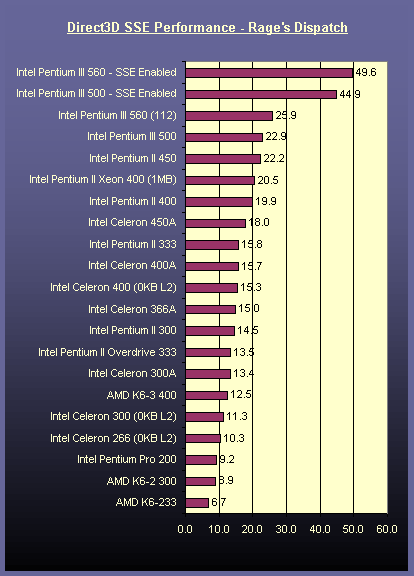
Reality, according to hardware.fr:
"Let's start with Dispatched first. This is actually a Rage Software game that should come out late 99, which Intel showed the demo at Comdex Fall to highlight the benefits of the SSE. Big interest, it is possible to enable or disable the use of SSE instructions at any time.
Nothing to say in terms of speed, it goes squarely faster once the SSE activated, + 50% to + 100% depending on the scenes! But looking closely at the demo, we notice - as you can see on the screenshots - that the _SSE version is less detailed_ than the non-SSE version (see the ground). Intel would you try to roll the journalists in the flour?"
SSE version is less detailed? How convenient! Rage Software Dispatched never came out. The only outfit, other than Intel, in possession of this software was Anandtech. They used this exclusive press access to pimp out Pentium 3 benchmarks manufacturing fiction like this https://images.anandtech.com/old/cpu/intel-pentium3/Image94....
While I am incredibly stoked for AMD pushing the envelope, this should be a gigantic sign to Intel that their entire market is about to be commoditized by physics unless they put every single dollar they have into pushing the envelope (AND get extremely lucky in the breakthrough).
Without the advent of Quantum computers, solving P=NP for our computational benefit, and/or some other unworldly mathematics, the PC industry is pretty fucked in ~10-15 years save those who transition into services.


.JPG)

A few key wins with the three cloud giants, and Intel will feel it. And the cloud giants can start with things like managed messaging, databases, etc, where it's not directly exposed to end users. Similar for the various high end AARCH64 CPUs. Intel is in for a ride.