But we do all have shared values. In fact, I think we all agree on most of everything. Imagine there was a button you could press where each and every person would suddenly receive at least a nice house, a bit of land to call their own, and a pleasant good paying job. There's not a single person, regardless of ideology, that wouldn't press this button. Another button to get rid of all crime? Yip, gonna be pushed. Another to get rid of all poverty? Everybody wants the exact same things. The only thing we disagree on is the best route to get there.
That said, I completely agree with you that there is a perception of the lack of any shared value. So why might this be? The 2016 election was interesting. How many people voted for Hillary thinking 'Yes, this person truly stands for what I believe in and will make a phenomenal president.'? How many voted for her because the alternative was completely unthinkable. And the exact same holds true for those that voted for Trump. Think about what a remarkable bit of social engineering that is. In a democracy, you've managed to get tens of millions of people to vote for people they don't actually like or event want in office. And all you had to do was to make people loathe, and fear, the alternative sufficiently.
Division helps entrench establishment forces. You can even see this in the choice of which issues get elevated to the national level. What is the weapon most typically used in mass homicides? What percent of homicides are rifles used in? I think the majority of Americans would get these questions completely wrong. Because the issues that we elevate paint a picture that is not in accordance with statistical reality. That reality being that pistols are the primary weapon of mass homicides, and with rifles being responsible for about 2% of all homicides. [1] Our homicide rate is driven by cheap little pistols. The year to year variance in pistol homicide is frequently larger than the entire sum of all rifle homicides. In other words if we had a magical button to get rid of all rifles, "assault" or not, you wouldn't even notice a drop in the homicide rate. It'd be statistical noise.
But the issue is promoted because it's extremely divisive. It makes people fear and hate one another and further drive this perception that we have no shared values. And what that translates to is at the polls you won't vote for who you want, but will instead vote against who you do not want. And that translates to voting for the establishment candidate who, by definition, will have shown themselves to be the most 'electable'. And then we all end up disappointed, and then do this again 4 years later. Only this time the establishment candidate is truly different, honest! Or in the case of an incumbent, they'll actually do what they've been promising now - they just need 4 more years, honest!
> There's not a single person, regardless of ideology, that wouldn't press this button.
You have vastly more faith in humanity than I do.
There is an entire class of people who define their success based on how much more they have than everyone else. It isn't enough for these people to be successful, healthy, and financially stable; it is necessary, for their happiness, that other people not have these things.
Many of the problems we currently face have, if not solutions, proven mitigations. These mitigations are complete non-starters in America, though, because a significant minority of people have been convinced that "those people" haven't earned it.
> It makes people fear and hate one another and further drive this perception that we have no shared values.
A more important issue is the fact that our legislatures are structured to have exactly zero concern for our shared values. If we take your cheap little pistols example (which is entirely accurate, as far as I can tell), we have one of those clear mitigations: universal background checks. This mitigation enjoys somewhere around 90% public support. It will never, ever pass as long as the NRA is allowed to terrorize politicians into voting against the public good.
I think the examples you offer are a pretty good example of the point. For instance you're presumably alluding to welfare, and people being upset seeing things such as somebody paying for food with food stamps while browsing on their $400 iPhone or walking their groceries out to their new car. It's not unreasonable to characterize this as somebody being unhappy because other people do not not have things, if you'll excuse the double negative. But is this really what it is?
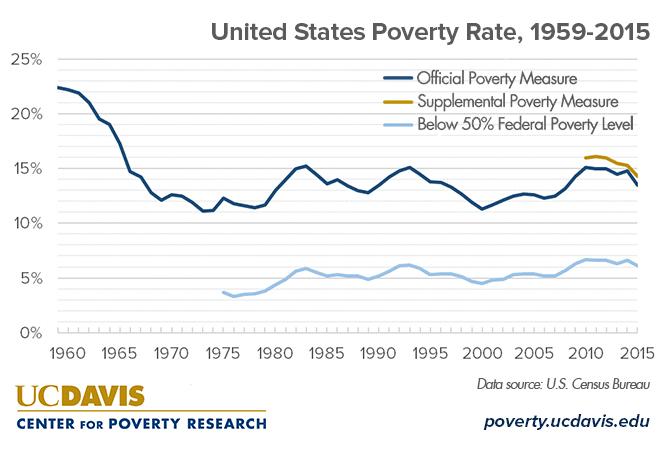
Should the purpose of welfare be to solve poverty or to sustain it? This is another one of those questions that I think we'd all agree on. Nobody wants poverty and so welfare, as one of our primary means of combating it, should do exactly that. It should combat it. Is it succeeding? This is something we can look for objective information on. This [1] is a graph of the US poverty rate. It's clear that welfare is not effectively reducing poverty. One of the oldest proverbs, that's generally appeared throughout the world in completely independent cultures 'is give a man a fish and you feed him for a day; teach a man to fish and you feed him for a lifetime.'
Our capitalist society is fundamentally unfair in one way. The best way to make money is to have money. Start as a billionaire and unless you're a complete idiot (or alternatively voluntarily engaging in extremely high risk enterprise) you're going to die a billionaire. And this goes all the way down. It's much easier to earn $15,000 when starting with $5,000 than it is to earn $10,000 when starting with $0 - even though it's the exact same increase in capital.
If a person is so poor they cannot reasonably afford to even feed themselves, is it a wise investment of what little capital they have to buy a luxury electronic device? Or a new vehicle? Is this the sort of behavior that's going to help them get out of poverty? I think people see these behaviors as a failing of the welfare system. Instead of getting people out of poverty, it's simply sustaining it.
And there are major corporate interests that are invested in sustained poverty. For instance WalMart in their SEC filings actually lists food stamps as one of their major profit conditionals [2]. About 20% of all food stamp outlays end up being spent at WalMart - around $13 billion in recent times. Quite an interesting system we've created. Welfare subsidizes low wages at WalMart, and then caps it off by directing massive amounts of money back to the company. Kraft Foods is another big advocate for welfare and its expansion. About 1/6th of their entire revenue coming from food stamp purchases.
And their are also political gains to be had from sustained poverty. Today around 40,000,000 people are dependent on food stamps. Politicians who promise to expand these sort of programs are likely to disproportionately receive their vote. This creates an incentive to simultaneously service these people, but also keep them dependent. See LBJ's quotes on how he viewed the Civil Rights Act (which he passed), or what he referred to it as privately, for an example of this issue. I will not repeat his language here.
This is really just scratching the surface, but this post is already unreasonable long so I'll cut it here. But I hope I've framed at least the start of a case for showing that when people are not necessarily the biggest fans of programs such as welfare, there are reasons beyond disdainful views of those receiving it, or a desire for them to stay impoverished.
> The only thing we disagree on is the best route to get there.
So we agree on most of everything, except this massive, critical thing?
Even aside from that, your examples of shared values also don't strike me as universally agreeable. I find many of these apparently agreeable things just poorly defined. It's much more obvious why these issues are so divisive when you dig a little deeper.
What exactly would getting rid of all crime mean? Because people disagree on what should be considered a crime.
Getting rid of poverty? Well, what kind of poverty do you mean? Because poverty in many ways is relative. Getting rid of all poverty implies getting rid of all wealth inequality. Is that really something you believe everyone agrees on?
Everyone owning their own land? I'd be surprised if everyone agreed on private land ownership. Everyone has a nice house? What kind of house? I'm not sure everyone wants to live in a suburbia.
>> Imagine there was a button you could press where each and every person would suddenly receive at least a nice house, a bit of land to call their own, and a pleasant good paying job. There's not a single person, regardless of ideology, that wouldn't press this button.
No I would not push that button. I think everyone should have a roof over their head, but only value-producing people should have a nice house.
Also, I think that the reward should be based purely on value production of the individual, without any regard for ownership of capital (the means of production).
Also, individuals should not be rewarded for capturing the value created by others (I.e. entrepreneurship).
There should be a clear distinction between activities which create value versus the ones which capture value.
We need a system which enables creators instead of entrepreneurs.
By the way, the word 'entrepreneur' is French and it literally means 'someone who takes what is between'; not someone who creates value.
>> Another button to get rid of all crime? Yip, gonna be pushed.
If we had a decent system, I would agree. But in the current system, I think that crime might as well just be legalized. The definition of crime is extremely unclear.
There are so many white-collar activities which are not considered crimes by the legal system but whose consequences are actually far worse for society than all the blue collar crimes added up together - In fact, you could argue that blue collar crime would not exist if it weren't for white collar operators rigging the game and effectively forcing poor people into a life of blue collar crime.
>> Another to get rid of all poverty?
Sure, but people need to be educated in order to be able to lead a socially conscientious life outside of poverty.
If you lifted everyone out of poverty with the push of a button, they'd eat the conscientious middle class for breakfast the next day.


Without values there is no good or evil, there is only power and those too weak to seek it.