> A new wall doesn’t contain [traces of its original craftmanship], even if it looks exactly like what once stood. “Do we clean it up and make it all look unified, or do we try to let the memory remain?”
I am very unhappy that Notre Dame burnt. Having said that, I don't see it as "oh no, history has been destroyed" but rather as "this is the history of the Cathedral". If it's still standing (and it seems like it will be), people will talk about this fire for hundreds of years, the same way we talk today about how it survived the French revolution.
Douglas Adams has a great quote on how a building its more than its materials, which you can read in [1]. If we use 3D scans and modern technology to reconstruct the Cathedral to the way it was, I wouldn't see it as "Disneyland" (as the article puts it) but rather as an example of how far we have come and what we can do when we put our minds to it, and how the story of our civilization is written not by design, but rather by accident.
Great take. Also good to remember that a Temple of Jupiter once stood where Notre Dame is. After that was destroyed, a basillica stood there, and then a Romanesque cathedral. That last one, which was nearly 700 years old, was torn down to build the Gothic style Notre Dame.
The people who built Notre Dame tore down what to them would have been ancient history. Those other buildings were hundreds of years old by the time Notre Dame was built. 800 years ago, Notre Dame was the change that destroyed a 700 year old historical building. And the new construction was built in a super-modern style. They didn't try to make it look like the old building they tore down, they built it with the most modern techniques in a super trendy style.
Much like death and rebirth are cornerstones of the Christian religion that Notre Dame represents, death and rebirth are fundamental to Notre Dame itself.
While I totally agree with your sentiment, I'm not sure how I'd feel about tearing the whole thing down and building something brand new in its place. Interesting to ponder why that is.
As we grow older we realize that nothing lasts forever but change. Gone is your childhood home, gone your school, gone the people who defined it.
it's nice to have something around that seemingly lasts forever like the earth and sky. Makes us feel home, when home is long lost too time.
>Gone is your childhood home, gone your school, gone the people who defined it. it's nice to have something around that seemingly lasts forever like the earth and sky. Makes us feel home, when home is long lost to time.
What makes monuments like Notre Dame or the pyramids special is that they DO imbue this sense of continuity. Everything else in our lives comes and goes, but a few things we as a society come together collectively to say "This is special and worth preserving." There is a special feeling of connection one gets from that sense of unity across time. These are the things that give us a sense of shared history and a shared future destiny. And it has the effect of simultaneously making you feel individually small and insignificant, but also important and part of something grand.
The first time I visited Paris I remember one of my most dominant thoughts was that nothing like this will ever be built again. There is so much in the art and architecture that, by modern standards, would be deemed wasteful and extravagant and a suboptimal use of resources. We don't value aesthetics in the same way. So when these things go, they're gone forever. Even if remade they will only ever be an imitation of a way of thinking and a way of life that has gone extinct.
They won't even serve to remind us of those old ways because the gestalt you get from layering generations of use and the peculiar artifacts of the material culture that created it will be gone. That's why people mourn. It's not just about the building, but the fact that the building anchors them to a sense of tradition and continuity.
And it's not the first time these things happened. It was mentioned that before it was a Christian church it was a temple to Jupiter in that location. Removing the old pagan monuments was a conscious effort to FORCE just such a break from the past. To say the old pagan ways are over and to sever any sense of continuity with that old culture and their old Gods. I'm sure it was just as troubling or traumatic then too.
We still have some collected myths and stories from the Romans and the Norse and so on, but a lot of these were written by Christian converts who were sad that the stories they heard on their grandparents' knees were going to disappear. They may have converted, but they felt like this was something important that needed to be preserved.
We still have some collected myths and stories from the Romans and the Norse and so on, but a lot of these were written by Christian converts who were sad that the stories they heard on their grandparents' knees were going to disappear.
We have Roman myths as written down by pagans pre-Christianity.
But our records of Norse myths were written down around 1200 AD, a couple of centuries after Christianity became the official religion in Scandinavia in 1000 AD. It is hard to say how much modification there was between those points.
The biggest change is that Odin/Wotan finished his long journey from being recognizably Mercury when the Romans met the Germanic people to absorbing a lot of the character of Tyr (aka Mars) and then becoming king of the gods. The historical root survives in language, Wednesday is still named after Wotan in English, and after Mercury in various Romance languages.
There is reason to believe that during Viking times, Thor was (like his analogs Jupiter and Zeus before) still the king of the gods. And therefore Odin's role as patron of kings and poets both was responsible for his elevation in the version of the myths that got written down.
I always did wonder how it came to be that the "Thunder God" was king in basically all the Indo-European pantheons except the Norse one. I suspected it might have something to do with urbanization and reliance on agriculture, but your explanation makes way more sense.
Out of curiosity, what are the arguments that Thor was considered the highest of Gods originally? IIRC many of the ceremonial items they found on the boats were dedicated to Odin weren't they? (Though I suppose that being an analog to Mercury, he would make a lot of sense for voyagers to adopt as a patron).
Historical accounts such as Adam of Bremen describing Thor as the main god at Uppsala, the frequency of Thor's Hammer versus other religious symbols, the many references to Thor in Icelandic sagas.
However Tacitus did describe Mercury at the chief Germanic god. So maybe Odin was the chief god after all.
The popularity of Odin could also be a reflection of their social roles. Consider the Lay of Harbard: https://thenorsegods.com/the-lay-of-harbard/. Elsewhere in the myths, Odin gives Harbard as one of his names, and it is believed that Harbard in this lay is actually Odin. Reading that, you'll see why the average peasant would be more interested in asking for Thor's help than Odin's. Conversely you'll see how a war leader would be more interested in Odin's help than Thor's.
Esp. since the Notre Dame still has the crippled unfinished main towers for ages, and looks much better with those. On the other hand, they decided to finish the Gaudí towers, and they really dont look that well. They should have left it at the Notre Dame half-stage
It's definitely high up on my list of things to see. If anything, I'm worried my expectations and excitement level are too high and can only be let down.
Not to push your expectations even higher, but visiting and seeing the Sagrada Familia literally moved me to tears. It's one of only two buildings that have ever done that to me. (And I'm not religious at all, and was not raised Christian.)
Been having those thoughts revisiting my old elementary school with my kid. Every teacher and staff member when I went there is gone, but in my memory there is a snapshot of that part of my life...frozen in time. Comparing that snapshot in time & space to what it is now is jarring. Nothing is permanent but change.
Presumably this iteration of Notre Dame was built by old men. Something must have changed at the societal level to make tearing down a 700 year old cathedral to make a new one possible in the 13th century, but seem unconscionable in the 21st.
A vast development in building capabilities and craft I think is the answer. I don't think we have more crafting capabilities now when it comes to architecture, we can build bigger, higher, etc.. I don't think we can build with a greater sense of human devotion to ones craft and it's use to glorify God.
Buildings now show incredible material science, technological development; but rarely the decades of learning of human craft directly applied to materials.
I think if we were going from rough-hewn to well-faced stonework, opaque windows or simple slits to translucent radiant glasswork, from flat ceilings to intricate vaulting, etc.. that we too would make that leap.
We are so much richer, we can afford to keep old stuff, hoard it even, and still have resources a'plenty to keep warm, feed everyone, and build glorious buildings.
In Rome I can think of one church (San Clemente Basilica) that was built on top of a pagan temple, which then had another church built on top of it, which then had the current church built on top of it. You can in fact tour all levels of it. Much of ancient Rome lies at a lower level than the current city, so those buildings are now basements or buried. In many cases that is what happened, not wholesale knocking down of the old buildings.
I've heard of buildings built on top of others before. Is it commonly because the buildings have actually sunk into the ground or are they somehow pushed?
Victor Hugo did a great job at reviving interest for the cathedral with his book. If it hadn’t been for him, it is entirely possible it would have been destroyed instead of restored in the mid 1800s, and you wouldn’t care much about it :)
There's an interesting point here somewhere about how a story being of greater cultural impact than the icon that it choose to portray. And yet most people would probably say that the icon itself, the cathedral, is of much greater cultural significance than the story. Or perhaps the two can't really be separated.
I think there's a lot to say about this. I feel that today's Zeitgeist doesn't favour radical renewal. It feels like it's quite anxious and conservative as a whole. We're unsure about the future and what direction to go as a species. And as often before we look for comfort in our ancestors.
I find this a fascinating point. In my understanding it's in complete contrast to the modernist architectural movement with its ideals of urban renewal.
Anyone have any other thoughts on this current Zeitgeist?
Personally, I think a lot of the current Zeitgeist is rooted in what Alvin Toffler called Future Shock[1]. Given that he wrote his book in the late 60's / early 70's, and considering how much technological change in particular has accelerated since then, I do believe that most of us are walking about in a "future shock" state.
I think part of it would be intent. I don't know that much about its creation, but I'm guessing the Notre Dame was planned out to survive a long time, much longer than a wooden structure of similar size. It was also built as a place of worship and of similar religious use. It wasn't something that wasn't going to be discarded if it wasn't "performing well".
I say all of this in contrast to e.g. tearing down the Notre Dame and putting up some real estate development that rents out stalls to merchants. Say the economy takes a hit and the owners start considering selling the land, only for the structure to be torn down again.
My point is that it'd be a tragic misuse if the structure fell into the hands of those solely seeking a profit from the structure/land.
Thats sort of how I feel about it being done in 5 years. Take your time, make it a big deal, its ok if you spend a lifetime on it. People who visit will get to say they saw it being built, while it was under construction. When it is finally unveiled at the end the story can be "this was xxxx years in the works."
It hasn't burned to the ground or suffered structural damage to the walls, so no one in their right mind is going to tear the whole thing down. They'll restore it.
I also think there is a really cool opportunity here to allow people to compete and donate to history.
If you look at the last major restoration "Once the project was approved, Viollet-le-Duc made drawings and photographs of the existing decorative elements; then they were removed and a stream of sculptors began making new statues of saints, gargoyles, chimeras and other architectural elements in a workshop he established, working from his drawings and photographs of similar works in other cathedrals of the same period." "Other craftsmen made stained glass windows in Gothic grisaille patterns designed by Viollet-le-Duc to replace the destroyed medieval windows in the chapels of the ground floor of the nave of the cathedral."
https://en.wikipedia.org/wiki/Eug%C3%A8ne_Viollet-le-Duc#Not...
Artists across France should be engaged to submit works with the promise that effort will be made to preserve them for centuries, if their work is chosen for inclusion. Even the stuff that doesnt make the cut could end up somewhere.
This suggests it was supposed to be fashionable. But fashion in the modern world is "trendy" we build in an attempt to court popularity. I'd imagine Notre-Dame adopted the style it did as part of the linear architectural development, constrained by Church tradition, and needs, and liberated by new building techniques. Not built for fashion, but for longevity and utility as a place of Worship. Perhaps that's why it centred around a traditional (in C11) Romanesque cruciform plan with tower. Indeed the initial build - I gather - didn't include the flying buttresses that enable the "opening" of the walls to far more glass usage.
IMO Notre-Dame de Paris represents something of a pinnacle of Church architecture inasmuch as we don't devote that much manpower or that many resources to buildings nowadays. That's right morally, I think, but means short of Gaudi's ongoing build such opulent Church architecture is firmly fixed in the past for Europe at least(?).
It would be fascinating to see a Gothic cathedral built in modern Europe, do we even have the craftsmen to accomplish it?
The design was absolutely used to attract tourists, and each cathedral was competing with all the others for attendence. That's why they were constantly updated, built upon, and in some cases: demolished to start again.
Except those tourists were called, "pilgrims". The money they paid to enter the building was what was used to fund the cathedral itself. See also, the Holy relics, like the Crown of Thorns. It's like a roadside attraction, except there's the hope of escape from earthly damnation and enter into everlasting peace in Heaven. Which I mean, that's a nice bonus. Such promises were made to those who worked on and/or financed the cathedral's building.
That whole system isn't in play anymore (The Catholic Church just doesn't have that power, or Monopoly over things like intellectual property like books and people who can read those books) and places like Notre Dame are in serious disrepair (before the fire). That's sort of the real tragedy: this fire probably could have been avoided if the money was there to spend.
I believe that the cathedral is owned & maintained by the French state, not by the church. Whether they scrimp on the cost of repairs I don't know; it certainly always looked to be in quite good shape to me.
Huh. So I wonder if some stone from the Temple of Jupiter got recycled into that basillica. And then into that Romanesque cathedral. And finally into Notre Dame. It seems pretty likely, from what I remember reading about other cathedrals.
This rebuilding would be a great opportunity to document that.
The Basilica of St. Paul's in Rome (https://en.wikipedia.org/wiki/Basilica_of_Saint_Paul_Outside...) has a very similar story. It's even older than Notre Dame (4th century) and was burned nearly to the ground in 1823 by, wait for it, an accident involving a worker repairing the roof. The church was rebuilt using contemporary methods and today it's regarded as a treasure.
I foresee a similar thing happening here. A 1000-year old roof is an architectural treasure, but it's also a 1000-year old roof, with all its attendant challenges. The church will (someday) be rebuilt in a grand old classical style, but with a soupçon of modernity added as well. I think will be in some sense better off as a result.
An alternative approach is to rebuild a replica while keeping the original sealed (non visitable)
It has been done for prehistoric caves for instance. For a whole building it's more tricky, but it could be fine to have it on a remote part of the city, and let people experience it as it was before.
That would also allow to do representation or over more risky uses that could damage the historical monument but would be fine in a replica.
But for caves this is easy, you just add a door. Notre Dame is the grand centerpiece around which Paris has been built and re-built. There is no way it's going to be encased in a warehouse with bus tours to a replica somewhere.
The same applies to painting replicas, and I think most people don’t mind if the original is kept for preservation and near perfect replicas are exposed/sold for viewing purpose in comfortable conditions.
I totally agree with your point that the Notre Dame fire is unfortunate, but that we have to accept it as the Cathedral's history.
However, I think that from an architectural and art historical perspective, we can do more than just reconstruct the Cathedral exactly the way it was. Art and architecture always change with their cultural and historical context, and I think it's one of human kinds biggest strengths to create something new out of old or destroyed artwork.
My father was part of the B-17 force sent to destroy the railway station next to the Koelner Dom. They were also ordered to miss the Dom if they could.
He was rather proud that they destroyed the station and missed the Dom.
Indeed. Rather than try to cling to historical accuracy at all cost, we can simultaneously honor and remember the past while putting our own distinct mark on things. After all, one day we'll all be history too, and it would be a shame to deprive students of the past of material. :)
[Greetings to the early-internet archaeologists of the 29th century, btw.]
Even more so that notre dame has been heavily restored by architect viollet-leduc in the middle of the XIXth century. Look at this photography from 1840: the highest peak that has collapsed was not there. https://fr.m.wikipedia.org/wiki/Cathédrale_Notre-Dame_de_Par...
Even though I'm not French, not Catholic, not Christian, and have never been to Europe, yesterday I felt this overwhelming sadness and embarrassment about this fire. I was embarrassed that after so many centuries it was my generation that couldn't manage to keep the Cathedral safe.
Though seeing those first pictures yesterday, with the cross glowing as it was, gave me a sense of okayness. "We" responded quickly to a super-unfortunate accident and I believe, based on several sources of comments/Twitter that I've been reading, that we'll be able to rebuild it.
I strongly believe that two-hundred years from now the history books will refer to "The fire of 2019" as a powerful entry of resurrection in the long history of the Cathedral.
> A new wall doesn’t contain [traces of its original craftmanship]
I will add one quick thing: if that's true the initial wall is lost (obviously), old craftmanship is not lost. There is an organisation in France called "Les Compagnons du Devoir" [1] that does exactly this: (re)build things the way we built them centuries ago.
This organization has stonecutters and carpenters that could help a lot redo what was destroyed last night, with the know-how of the past.
So yes indeed, nothing is "lost", this is just another part of the cathedral's history.
I hope that they would not just try to re-create the past. That is impossible. I'd like to see the rebuild incorporate the absolute best of what we know from the past and modern techniques.
“Modern techniques” are specifically calibrated and engineered not to last on the timescale of Notre Dame due to the costs involved.
Modern construction techniques are of very little use to repair a building which was itself built over the course of 150 years.
“Modern” gets you the $200mm staircase to nowhere at Hudson Yards in NY.
The question is for a building which actually struggled to raise the $7m used for the initial repair project, are people going to be patient enough to spend the $700m and 10/15/20 years to rebuild it with anything approaching the care, quality, and craftsmanship of the original?
The reconstruction should be the life’s work of a great master (or several great masters, when you consider the art and ornamentation that goes along with the architecture).
Modern techniques certainly can be used to build crap, but that is hardly a requirement. I bet they built plenty of crap a thousand years ago, too. I am very confident that we can build structures today that are better than anything ever built, when we choose to. Thing is, for most utility structures there is no particular benefit to building for that kind of longevity.
A good share of notable cathedrals have burned in recent history, and some of them have been rebuilt using modern techniques (e.g. Chartres, one of the most notable french cathedrals now has a metallic structure to bear its roof). These new techniques are both elegant and a better fit, as they protect the building from a (likely) fire in the future.
Arguing that cathedrals' wooden roofs are built to last while we don't know how to build longer-lasting work is a very curious take on the situation.
> The question is for a building which actually struggled to raise the $7m used for the initial repair project, are people going to be patient enough to spend the $700m and 10/15/20 years to rebuild it with anything approaching the care, quality, and craftsmanship of the original?
I'd wager yes, this probably woke people up that they've let their country's icon crumble, and money (and time) will now be no objects.
> The question is for a building which actually struggled to raise the $7m used for the initial repair project, are people going to be patient enough to spend the $700m and 10/15/20 years to rebuild it with anything approaching the care, quality, and craftsmanship of the original?
Something like 10 hours ago I was seeing a headline that €650 million had already been pledged for rebuilding from various private sources, so, yeah, I think it's reasonable to think that the money will be there.
Too late to edit, but early estimates on the repair costs are actually $8 billion.
The roof that burned was called the Forest because it was made from 13,000 whole oak trees (the number varies depending on source) spanning 52 acres of forest.
Then I'd be ok with replacing it with an identical "forest" made out of a modern material like carbon fibre, representing the original forest lost in the fire. Maybe we can even dedicate some area of land for oak growing so that in 300 years the trees will be ready to remake the original roof.
Apparently one of the major challenges in replacing the roof in the old style is that the typical oak used to construct it would have been ~300-400 years old and they just don't have a lot of those around anymore.
There are agreed principles for the conservation of buildings. Three basic ones are:
a) Replace like with like (don't change materials or construction techniques)
b) Make any repair work obvious (don't try to pass new fabric off as original)
c) Repairs should be reversible.
It's a complicated field, but the general spirit is that when a building needs to be repaired, you try to make the new elements match as closely as possible to the way the structure was when it was first built. You don't say "we know better than the medieval masons, so we'll use reinforced concrete instead of stone" because that wouldn't be a restoration. It would turn the building into a hybrid of old and new technology, when what everyone wants is to experience the old way of building.
There's also an element of arrogance in trying to improve on medieval architecture—most people would agree that architecture, as an art, isn't something that progresses inexorably like science. The cathedrals are already as good as architecture gets. "Updating" a medieval structure to use the trendy structural technologies of the 21st century is a barbaric idea, because it is literally a case of destroying or interfering with an irreplaceable artefact.
Obviously, not every old structure has to be treated with kid gloves as a priceless artefact. But I hope you can see what I'm getting at when I say that "best practice" in building conservation means not acting as if you know better than the original builders. It's a case of respecting the original design and not messing with it for the sake of employing modern technology.
>There are agreed principles for the conservation of buildings. Three basic ones are:
>a) Replace like with like (don't change materials or construction techniques)
>b) Make any repair work obvious (don't try to pass new fabric off as original)
>c) Repairs should be reversible.
I don't think everyone agrees to this. At least, I don't. It's absurd to put a wooden roof back onto a structure seriously damaged by a roof fire. Whatever goes up there should be non-flammable. At minimum something that won't crash in the roof again in case there is a fire. Rebuilding it in the same fashion would be monumentally stupid.
Setting aside the safety issue, I go back and forth if it should be restored in exactly the same way. Notre Dame has been modified and improved over time and I don't necessarily think it needs to go back exactly the way it was. Like the glass pyramid in the Louvre perhaps modern materials can be an improvement.
I think it would be a little insulting to try and replicate what was completely destroyed. Repairing something that has been lightly damaged or degraded over time is one thing. But when it's gone, it's gone, and the parts that are rebuilt should reflect our times, with a healthy nod of course to the existing structure that still remains. This is the next chapter in the building, something people will look back on a thousand years from now. We should make something we can be proud of.
A lot of aspects of Notre Dame date to the 19th C. Viollet-le-Duc made a lot of questionable improvements, including the addition of the flèche (spire).
That's part of the building's history now, for better or worse. I expect Viollet-le-Duc's work will be restored, even if some people think he was crass.
This whole issue isn't something that can be resolved easily. It's important not to look down on the activities of repair and maintenance. They might not be as glamorous as artistic creation, but obviously there's love, skill and creativity involved in repair as well. We need more of that.
A bad intervention by a currently successful artist or architect would be nothing to be proud of in future years. "Move fast and break things" is not appropriate in this situation. It's not as if a repair job involves pure boredom, imitation and humility—those craftsmen will be expressing themselves and their passion just fine.
The 19th C fixation on romantic originality, on the heroic artist? We don't need that. Not to be cynical about the state of architecture, but we can't match even Viollet-le-Duc's iffy work now. We need to shift into a different mode with more emphasis on preserving building skills and historical artefacts than on altering them to suit the whim of the people who happen to be alive now.
I think the Frauenkirche in Dresden is a counter example. That was reduced to a shattered hulk and rebuilt with as much of the original surviving stonework as possible.
Construction technology is not the same thing as architecture. Architecture as an art doesn't progress.
Music is the same, painting is the same. A piece of medieval music can be perfect on its own terms. It wouldn't make sense to say that electronic music is better because the tech is more advanced. Artistic value and technology are totally separate issues.
I didn't say that they stayed the same. The point is that you can't say objectively that these arts have progressed any more that you can say that human nature has changed for the better.
What I'm saying is not an unusual opinion. I mentioned electronic music, so it should have been obvious that I'm aware that "things have not stayed the same". But the point I'm trying to allude to is the fact that art is an expression of the human spirit, and because of that, it doesn't advance like science or technology.
Here's an example of someone writing in the Guardian:
"It was a year of revelations. The oldest portrait in the world – carved out of mammoth tusk 26,000 years ago in Moravia – had a long slender face, almond eyes and a rueful half-smile: just like a Modigliani. She came to the British Museum along with Ice Age drawings and sculptures so superb they have never been surpassed, proving once again that there is no progress – only change – in art."
Or, on a slightly different point:
"It is obvious that art cannot teach anyone anything, since in four thousand years humanity has learnt nothing at all." (Tarkovsky)
Tarkovsky obviously isn't denying the growth of scientific knowledge. He just thinks there are aspects of human nature that only change slowly, if at all, and that those aspects are more significant than the accumulation of scientific knowledge and all the changes that brings about.
I guess it depends on the definition of progress. I see people able to do things previously impossible, which I say is progress, and you say that is not progress because the new things are not objectively better.
Acquiring the ability to wipe ourselves out with nuclear weapons is the classic example of this problem. The physicists weren't expecting that pushing the boundaries of what was technically possible would result in a very bad escalation of destructive capability, nuclear arsenals and the rest.
Progress in nuclear physics hasn't got a lot to do with progress in human politics and (dare I say it) justice/peace.
Construction technology is similar vis a vis architecture. Revit, 3D printing and advanced materials aren't an automatic ticket to making architectural work that's as good as or better than Angkor Wat. I mean, just what materials you build something out of, and what technologies you use, both obviously contribute to the particular artistic problem that the architect solves. But someone working with very limited technology can produce a fully developed artistic masterwork under those constraints. That's just something we know empirically from looking at the art of the past.
So this is more about never being complacent that what's being made today will match or surpass the artistic high points of the past. That's what the "no progress" concept means to me. There's a level playing field—none of us has any kind of technology that means we can unthinkingly produce work that compares well with renaissance masterpieces. The real picture is quite a bit more depressing that that...
I hope they don't. Having seen the jarring modern takes on stained glass inserted anachronistically into old church settings, I have little faith that 'new takes' are able to blend into old surroundings.
There is beauty in reconstruction, and calling it 'fake' misses the point.
I like this outlook very much. I remember a visit to Coventry Cathedral (https://en.wikipedia.org/wiki/Coventry_Cathedral) when I was at school, and the destruction of the old building had just become part of the history of the site. There had been no attempt to rebuild the old cathedral, just an acceptance that a tragedy had occurred and that there were lessons to be learned.
Egad, I hope one of them was that modern architects shouldn't be allowed near a building project. To see the ruins of that beautiful old cathedral next to that atrocity against beauty is almost physically painful.
Exactly! Time and physics doesn't care about history. Wood will rot, metal will corrode, stone will weather. Hell, the earth itself is undergoing continuous reshaping every single day. This rebuilding is just another chapter in the cathedrals history.
Besides, think of how prestigious it sounds to say you played a role in the reconstruction an 850 year old national landmark. I know what jobsite I'd like to work on if I were a master carpenter.
I cannot agree more. I'm also unhappy about a fire, but rebuilding, fixing an old thing to be like a new one, it is a part of a history of the thing. Such a stories enrich history.
In a child age I weaved a spider from wire. It was a state of the art toy, I used techniques of making wire toys I learnt from others and extended them futher with my own inventions. And I remember how I played with that "robotic spider with computer mind" by chopping it with a knife and then fixing damage done. (It was like spider got a serious fight and was damaged) Every iteration was a fun and in a very short time my spider become a battered and somehow much more valuable for me. It was so much fun that I almost chopped off my own finger accidently.
I mean, this is somehow an inherent property of a human perception of things: past events connected with a thing cast a shade on that thing and with a time passing the thing becomes a container of the memory for all that events, and for all the times when events took their place.
It reminds me the project of rebuiling Tally Ho[1]. You can change all the wood the boat was made of, but it would be the same boat. Moreover, the ongoing project of rebuilding Tally Ho enriches history of Tally Ho beyond imaginable, maybe all the previous 100+ years history of Tally Ho is being outshined by the current events in her life.
The Reims cathedral suffered very heavy damage during WW1 and was rebuilt in about 20 years. Looking at it today, you'd hardly know the extent of the damage.
I think what hurts really is the fact that a cathedral that took 200 years to be built, and had been standing there for 800 years can burn down in a single night. It makes one wonder about the vanity of many of the humanity's achievements and it's a harsh reminder that everything eventually comes to an end.
Reminds me of an article I read about attempts to restore a Ferrari that had crashed and burned. It had been totally destroyed, the only thing salvageable was the serial number plate.
The debate was, of course, whether this project was a restoration or a replication. I don't think there's a difference.
A few years ago I visited a hangar in Everett where some enthusiasts had borrowed an Me262 from a museum in order to take it apart and produce mechanical drawings of everything. Then they built flying replicas from the ground up and sold them. Some changes were made for safety and practicality reasons.
So were they real Me262s or not? I'd say they were real. I wished I could have bought one.
The market certainly distinguishes replicas from originals, even in situations such as you describe. For example, modern replicas of 19th century firearms can be 10x cheaper than the originals, even if they are perfect reproductions down to materials used. So, whatever the reason, people do care on average.
Exactly. There aren't many old structures that don't have a history littered with damage or complete destruction and rebuilding. Natural disasters, invaders, accidents. I like to think that those events are becoming less frequent with increasingly better tech and a more civilized world. This one was an anomaly I think. It will be interesting to learn the cause(s) and see what practices might be put in place to avoid them in the future.
I think Japan has some interesting ideas about this. Many of their most famous temples have been completely destroyed (either by being burnt down, struck by lightning, or leveled by earthquakes) at least once in their lifetime, but they always get rebuilt, and are no less the same temple
At least, this is implied by the signs saying 600 year old temple, when in fact the current building was built 150 years ago.
Agreed. It's just a thing. It's still standing and will be reconstructed. Does it really matter if the wood is original? No history was "destroyed" in any sense.
The thing that amazes me about Notre Dame, and several other structures of that era, is that it took 200 years to build. The reason this is so amazing is that the architects and planners knew it would not be completed in their lifetime, and yet they progressed for a greater cause.
We don't really have projects like that anymore. Contemporary structures and infrastructure are designed to be completed within the lifetime of the creator.
We might be able to attribute that to advances in technology allowing for faster development times. But sometimes it seems we've lost sight of the grandeur that existed at those times, and perhaps we are not challenging ourselves enough.
> "We don't really have projects like that anymore."
See Gaudi's Sagrada Familia for a modern day equivalent. Under construction for 137 years and counting. Current estimate for completion is in the 2030s, if all goes well.
(I highly recommend the guided tour if you're ever in Barcelona. The history of it's engineering and construction is fascinating even if you're not that into Gaudi, or cathedrals.)
>> I highly recommend the guided tour if you're ever in Barcelona. The history of it's engineering and construction is fascinating even if you're not that into Gaudi, or cathedrals.
I can absolutely agree on this. As a staunch atheist I have no relationship to religion or the catholic church, but the creativity and dedication of this man is really fascinating -- even his death had a relation to the building. The architecture is truly awe inspiring and so rich in detail, you could surely spend several days there and discover something new every day.
From an engineering POV what has inspired me the most was the method with which the stresses/strains of the structure was modelled (without numerical methods or finite element analysis).
Metro networks, airports and universities are also very good examples of architectural structures that have been or will be built over many generations. Metro networks are particularly good examples because they truly are built from rock unlike pretty much any newer huge building in modern countries (Sagrada being an exception). Back in the days, only kings and powerful religious groups could build such structures.
It's a very different situation though, a cathedral can't really be used until it's finished or at least significantly complete.
A complete metro network might take 150 years to build but each line is useful on their own, the final network is composed of several semi-independent lines which get added and expanded over time, and even if the system's fulness is designed at its origin with multi-decade plans it's useful long before that.
Same with road & highway systems, or other public transport networks (trains, tramways, …). They're useful and have a point long before they're "finished", assuming there's even such a thing.
Many medieval buildings have developed in the same way, though. I don't know if it's true for the Notre Dame, but plenty of cathedrals and castles started out much smaller than they are today, and saw regular expansions over the course of centuries. And that iconic spire of the Notre Dame was added in the 19th century.
The Long Now Foundation was established in 01996 to develop the Clock and Library projects, as well as to become the seed of a very long-term cultural institution. The Long Now Foundation hopes to provide a counterpoint to today's accelerating culture and help make long-term thinking more common. We hope to foster responsibility in the framework of the next 10,000 years.
Fascinating. Reminds me of the Neal Stephenson novel, Anathem, in which academic enclaves exist for the purpose of safeguarding knowledge for the long haul and against external calamities.
Long Now Foundation is thinking about the distant future, but as far as I understand the building phase of their current projects will be completed within a single generation.
>The thing that amazes me about Notre Dame, and several other structures of that era, is that it took 200 years to build.
Not really. At least not in the sense that structures are built today. The first mass was held just 19 years after construction began [1]. And many additions were added, and plans modified along the way. It's not like the original plan was 200 years of construction before it would serve any real useful purpose. There was actually construction being done at the time of the fire, but that doesn't mean it took 900 years to build.
>The reason this is so amazing is that the architects and planners knew it would not be completed in their lifetime, and yet they progressed for a greater cause.
And got paid (which, in fairness, still means the money-men were thinking that far ahead).
>We don't really have projects like that anymore. Contemporary structures and infrastructure are designed to be completed within the lifetime of the creator.
The deep space probes from NASA took something like 20 years to reach their destination, on top of the mission planning time, and involved a lot of senior engineers, who didn't get to see it to completion. But you're right, I can't think of anything on a 100+ year timescale.
I wonder, in all that hierarchy, and in all those networks, who was "thinking far ahead", and who was cynically participating in the endeavor for personal gain, while quenching existential thirst elsewhere. In modern society, the majority of our lives are spent in the latter mode, I think: no one's passionate opus is sugar water or targeted ads, yet they occupy millions of us.
Incredible things can be done by people who are "phoning it in," by firms stacked top-to-bottom with talent whose passions lie elsewhere.
Is it possible that cathedrals, too, were constructed entirely obligatorily?
> We don't really have projects like that anymore. Contemporary structures and infrastructure are designed to be completed within the lifetime of the creator.
Well, it might not be intentional, but the new Berlin city airport certainly looks like it's going to be a contemporary example.
On the other hand, what kind of useful projects would take so long to build today? Even massive infrastructure like the Channel Tunnel or the Panama Canal can be finished well within one lifetime.
Technology changes too fast for that to be reasonable these days. Let’s say I design some massive bridge that will take 100 years to build. Why would we start construction today, when technological changes might render it completely obsolete before it’s even done?
The fact that people were able to plan and execute a centuries-long construction project for a monument to society’s shared imaginary friend is fascinating and speaks well of them but it doesn’t seem like the sort of thing we should strive to emulate.
Space exploration comes to mind. What if we decided to send a probe to a nearby star system to explore its exoplanets? Even with superior propulsion technology, the probe might take hundreds of years to get there. Which means we'll need to find a way to keep the probe's computing and communications systems functional for all those years, not to mention maintain compatible systems on Earth. Moreover, once the probe reaches its destination, any command we send will take several years to take effect.
If you were doing it today, you’d be better off putting your effort into improved propulsion. A time may come when you hit the limits and need to carry out a very long project to send a probe to another star, but we’re not there now.
There's always going to be better propulsion just around the corner, at least until you reach something like 0.999c. At some point you just say "fuck it, we're launching this probe now."
The point when your probe arrives soonest is not the point where your propulsion technology is fastest, certainly, but that point is very unlikely to be now.
That’s exactly what ended up happening with the Sagrada Familia in Barcelona. The construction was originally going to take much longer, but modern construction technology has made it possible to finish sooner.
Does the cathedral of of St John the Divine in New York count? Planning started in 1887, construction began in 1892, the first services were in 1899 (in the crypt!), the cathedral was fully open in 1941, construction was disrupted by the war, and construction was continued in 1979, with the last scaffolding removed in 2007.
Sagrada Familia in Barcelona is another (even more famous) example. Started in 1882 and still is under construction (current completion estimation is 2032).
> "We don't really have projects like that anymore."
Well, there is the ITER nuclear fusion reactor project. It was planned in the 70ies, construction started in the 90ies, projected construction-finish will probably be around 2025 and the first projected long-term-stable plasma will probably be achieved around 2035. OK 60 years is not 200, but this still is far longer than any other contemporary infrastructure building I can think of.
Does Dwarf Fortress count? It may turn out to be just one lifetime of work, but what appeals to me romantically about that crazy product, is that (until recently anyway) it was never in any rush to appear complete, and one could imagine a future, like a software Sagrata Familia, that it could survive it’s original crazy/genius architech and people could pick up the torch and continue to add even more baroque and unfathomable complexity for at least another century or two.
The Eisenhower interstate system took decades to build and is still receiving incremental improvements. We will probably continue to use it for centuries.
But was it funded by that organization? I was under the impression that big projects like cathedrals were used by the church as essentially huge visible PR projects, which attracted funding from people who wanted to be seen to donate (providing PR for themselves). Some of the funding might also have been siphoned off to the church itself, I can imagine.
This pattern continues today – witness the speed at which funding for rebuilding has been publicly pledged by people wishing to be widely seen to do so.
It is amazing. They started with chisels and though the original tools are also still employed they use additive manufacturing and cnc as well now. Because of those advances and generous funding from some Catholic societies it will complete many years ahead o shedule with more features than it woul have had.
Isn't one reason for this because it's such a huge attraction generating so much money, that finishing it might actually bring in less money? That's anecdotal from my Barcelona colleagues complaining..
> The reason this is so amazing is that the architects and planners knew it would not be completed in their lifetime, and yet they progressed for a greater cause.
Not only that, but the ones who followed them didn't balk at working on a "legacy" project.
Many of them did in fact object to working on a legacy project. Many long term projects have significant architectural changes over the years, meaning that the whole is not completely consistent in style. The Spire at Notre Dame for example (added in the 1800s) is one way latter generations objected)
We have infrastructure that is under continuous maintenance, too. Sure, it is already completed but we are repairing it for both the close and far future.
And we plan new bridges and tunnels that might never benefit the people that drew up their first plan.
At the individual level I'd like to think that there are many people who care about future generations and find motivation to work towards their benefit. I don't expect me or my generation or my children's generation to live on Mars, but I still see space exploration as a multi-generation effort to benefit and possibly preserve future people.
Not that I'm thinking about all that while struggling with a race condition.
It sometimes seems that democracy, somewhat paradoxically, trends towards division. The grand projects of times past were generally created by entities where their successor would generally be vested in their success. Be this in the form of religions organizations or non-democratic political entities such as monarchies.
In democracy this kinship frequently does not exist between successive entities, and there is even often an effort to dismantle the works of a previous administration as well as blaming any faults on them. There are also basic democratic political problems. One very myopic, and very common, political argument is of the form: "You want to [do something amazing] while there's [people dying of cancer] [kids starving to death in Africa] [etc] [etc]?!" This argument feels reasonable to most people, and can be used to frame a candidate (who wants to do grand things) as being out of touch. And it's extremely effective. It makes it difficult to spend large amounts of money on things outside of those that can be justified on a very immediate level, such as war.
The space program is probably the greatest project the modern United States has engaged in. And if it had carried on it's likely our species would now today inhabit bodies beyond just this planet. But it was not continued. This [1] is a song from the 70s that was published shortly before Nixon, who had a long standing animosity with JFK since losing a razor thin election to him in 1960, would completely gut the space program - which was very much a reflection of JFK. So determined were his efforts that in 1972, as Apollo 17 was returning to earth during his presidency, he stated "This may be the last time in this century that men will walk on the Moon." He initially even wanted to cancel both the Apollo 16 and 17 missions fearing that a mishap during them could negatively affect his reelection chances. The entire space program emphasizes all of the issues with democracy and grand projects.
that's moving the goalposts as to what constitutes took X years to "complete". you can use any of those things after a few years of construction. But they are boundless for expansion.
I have a hard time grasping what this thing could even be. Technology seemingly moves much faster now than it did back then. Anything we start now, in 200 years could look like it was started in the stone age. But again, i cant even imagine what that something is.
After millenia of using horse powered travel we've gone from vehicles, to planes, to the moon, to mars in about 100 years.
The Liverpool and Manchester Railway (steam powered trains): 1830.
Daimler (internal combustion cars): 1892.
Wright Flyer III (plane): 1903
Apollo 11: 1969.
Even steam powered trains were almost inconceivable to the average person living in say, 1700, just imagine what that person would have thought about Apollo 11! Heck, I imagine even Napoleon in 1821 couldn't really imagine the mechanized world awaiting just 50 years in the future.
Imagine how big of a stone structure we could build if we used modern CAD and CNC and just stacked giant bricks for 200 years. We should be one upping the pyramids and churches.
The Dom of Cologne (Köln) was finished in the 19th century, and the roof supports (not visible from inside or outside of the church) are actually made of steel. It's amazing to see this relatively modern technology in the "attic" of the church.
We've gotten really good at using petroleum and electricity to accelerate building construction, to be sure.
But we still have public works projects that span eras. Some of our big infrastructure projects, and things like national parks are constantly evolving. If I were president I could make a national park today but it's just lines on a map. Generations of work may have to be done to turn it into a functioning forest, especially now when we are questioning what the definition of 'functioning forest' is and how humans fit into it. Whatever we build today, we know it's gonna be wrong and a great deal of it will have to be redone.
I figured that would be under the petroleum and electricity column but sure, that's definitely true. They also use some mighty damned big trucks and explosives in quarries. I wonder how much of the 80 years of building a cathedral is just sourcing and paying for the stone.
I also love the solution Christopher Wren came up with after the Great Fire. Everyone wanted him to design their church. He made a compromise: I'll build you your church but you don't get a bell tower until after everyone else gets a church. So he went around building churches and then swung back through to add bell towers onto them.
> We don't really have projects like that anymore. Contemporary structures and infrastructure are designed to be completed within the lifetime of the creator.
Most projects but not all. This is why spacex has such a big fan base because if you have seen their pictures of mars, they are not only trying to colonize it, but terraform it and even options like sending hundreds of nukes at the poles to induce warming and atmospheric buildup are expected to take hundreds of years.
Well, the workers did it out of a sense of devotion, and in some cases as a way to guarantee their spot in heaven. They Catholic Church would use this quite a bit. For example: Commission a grand religious painting? Go to Heaven. That's why you sometimes see the people who paid for say, a mural in the mural itself getting blessed by ol' JC himself.
> We might be able to attribute that to advances in technology allowing for faster development times. But sometimes it seems we've lost sight of the grandeur that existed at those times, and perhaps we are not challenging ourselves enough.
I'd argue it's a good thing that our modern political systems aren't well-suited for pissing away our society's resources on monuments to hubris.
What about mega-scale engineering projects? E.g., a space craft to Alpha Centauri, to study another star close up? It's 4 years at the speed of light, and it'll likely take us much longer. Or what if the planet there orbiting Proxima Centauri b in the habitable zone is capable of sustaining life, and it could be our first stepping stone off of Earth?
For that matter, what if a megaproject is required for a space faring race, and democracy is the great filter?
Let’s say we started a project to send a probe to Alpha Centauri. With the entire world dedicated to the task, the probe could probably be launched in a decade or two, and would reach its destination in maybe 30,000 years.
Or we could forget about the probe and focus on developing better propulsion technology. That would have immediate applications, but could also allow the probe to reach its destination orders of magnitude sooner.
I don’t see any reasonable motivation for generations-long megaprojects until technology has well and truly stagnated.
We spent a trillion dollars sending a man to the moon. We can do megaprojects if the exigency exists. But the bar for exigency is much higher now and that's a good thing. Notre Dame, by contrast, never did a damn thing for the French peasants that were taxed to pay for it.
The type of megaprojects being discussed in this thread are those that span lifetimes. Getting a man to the moon — without dismissing its huge impact, it was definitely a great work of mankind — was still done within a single lifetime.
I posed Proxima Centauri simply b/c it wasn't religious, and perhaps palatable as something humanity should undertake, but not feasible within a lifetime, as a counter-example to show that not all lifetime-spanning projects are worthless.
Amusingly, I suppose that war, and the urge to beat the Soviet Union, is what even got people to the moon in the first place. Without it, I sincerely believe we still wouldn't have been there.
If the Cold War was still raging and Russia decided -today- to colonise Mars, it'd immediately go from a "someday/maybe" to "within the next 5-10 years".
> Modern McMansions are a sneeze away from falling apart.
Even ignoring the hyperbole, this isn't accurate. It's only because of survivorship bias that we think of building standards as having decreased over time, but they really haven't. Take an average person from an average house 500 years ago and put them in modern construction and they would be amazed by how nice it is, how it's well-insulated and climate controlled, how smooth the walls are, how level the floors are, and even simple stuff like how the roof doesn't leak one bit when it rains.
There's going to be many more modern buildings still standing hundreds of years from now than there are buildings from hundreds of years ago still standing now (both in absolute numbers and proportionally).
Take your hypothetical person from a half millennium ago - yeah, they'd be amazed by how comfortable the house is, and all that... but they'd also likely be appalled by the level of maintenance required to maintain that, both in terms of the actual structure and the amount of work necessary to fund the ongoing use of things like air conditioning and electric lights. With that taken into account, we spend a good deal more of our lives providing ourselves with shelter.
Also, as part of that, there's the fact that the home of five hundred years ago was likely built with the most durable materials that were feasible for the time and budget. Today, even the most expensive homes are made of materials that explicitly will not stand the test of time. In fact, I'd go as far as to say that our culture values things that are more fragile and fleeting - a home with a beautiful bay window is a thrown rock away from being essentially uninhabitable until that window is replaced, at great expense. We delight in our ability to impact the world around us, and very rarely build things to last longer than they need to.
Survivorship bias is heavily affecting your views on what previous era housing actually looked like. For example:
"they'd also likely be appalled by the level of maintenance required to maintain"
Modern materials have much lower maintenance requirements. You can put up a tar-asphalt roof and aluminum/vinyl siding and be fine for multiple decades without needing any maintenance whatsoever. Meanwhile, a lot of older houses needed extensive maintenance every year to keep the roofs and walls in passable shape. Wattle and daub was a common material used for walls, for example, and thatch a common material for roofs. Both are incredibly labor intensive to maintain.
"With that taken into account, we spend a good deal more of our lives providing ourselves with shelter."
Huh? How are you measuring this? The average person centuries ago lived at just barely subsistence level. They spent most of their efforts on basic survival, and sometimes didn't even have enough to eat. We spend much less of our lives laboring now than our ancestors used to. Compare how hard and long a subsistence farmer or serf works vs a modern office worker. It's much easier for us to provide shelter; we just spend some fraction of our salary on it.
"home of five hundred years ago was likely built with the most durable materials that were feasible for the time and budget"
Yeah, so only the palaces were built amazingly well and everything else was not. The living standards were so much lower back then that almost no one had the money to get access to the best available stuff, whereas nowadays most people do.
"a home with a beautiful bay window is a thrown rock away from being essentially uninhabitable until that window is replaced"
I don't even understand this criticism. The only way to not have this be a problem is to literally not have glass windows at all. Either you have an empty hole in your wall that's terrible for retaining warmth in cold weather and keeping out bugs and rain, or you don't have holes in your walls at all and live in darkness (both were common options). Would you seriously rather live in a house without windows??? To the extent that people didn't used to, it was only because glass was so expensive that the average person couldn't afford it. Now that we have modern production methods, glass is cheap, and everyone can benefit from it. I guarantee you that if you went back in time offering free glass, the average person would gleefully put it in their house. It was only used in palaces, cathedrals, and the like because of how expensive it was.
The average person 500 years ago lived in what you would call nowadays a ramshackle hut. I don't know what is coming into your mind, but you're probably thinking of one of the few well-made structures that persists to this day, rather than what was actually commonplace. Keep in mind that entire cities used to burn down too, which no longer happens in good part because of modern fireproofing codes and materials. Drywall, for instance, is an amazing material.
Re-reading my comment, I can see that I rambled quite a bit.
The overall idea that I'm trying to get across is that the best homes of today are not nearly as durable as the best homes of 500 years ago. The historical home would have had likely had stone walls if the owner could afford it, and a heavy timber-framed roof with lead or zinc overlaid for protection from the elements - exactly like Notre Dame, in fact. A modern home of the same cost (i.e., belonging to a person of equivalent economic class) is going to be much more comfortable but is much less likely to stand the test of time - at least, unless it substantial ongoing maintenance.
To put it another way, after a hundred years of abandonment, the historical home would likely still be standing. Barring extreme weather, the roof would likely be still in place. A modern home however would decay much more quickly, because of the assumptions that we make today about the availability of quality materials for repair and maintenance - and yes, because the materials to which we have access today allow architectural styles that were previously impossible, like huge bay windows.
Why does it matter that a house survive for 500 years, though? Seriously, I'm not going to live that long. None of my immediate descendants will either. Odds are good it'd be owned by someone else before I even die, let alone by anyone even tangentially related to me 500 years in the future. And odds are also good it'd be torn up well before then or fall into decay even if it was built to last. How many cities have been on an upward trajectory for the past 500 years? And how many old buildings have been torn down to be replaced with something bigger and taller, regardless of the state of the old building?
Give people a choice between two houses, one that will last their full lifetime and then some, and another that costs double and that will last 500 years, almost everyone is rationally going to pick the former option. There simply isn't much present-day utility in over-building to such an extent.
And keep in mind, there are plenty of all-stone buildings that have collapsed from earthquakes and other natural disasters, killing many people, e.g. https://en.wikipedia.org/wiki/August_2016_Central_Italy_eart... . A lot of construction methodologies that last 500 years only do so in some environments. Against a lot of common risks, a modern building constructed of dimensional lumber is better.
And anyway, I still think the better comparison is between the average building in different time periods, not the best buildings (which are basically just outliers).
> We don't really have projects like that anymore.
I think we still have those projects but they are more utilitarian rather than religious. Chernobyl and Yucca Mountain will be our generation's cathedral to nuclear power. Outside of the weirdly curious I don't imagine it as a major tourist destination.
The 10,000 year clock is a relevant contemporary example. Not exactly the same situation, but similarly it's a project that won't be seen to completion by anyone involved in it (if completion means the clock working as intended for 10,000 years).
Also, some of our space missions are like this, e.g. Voyager 1.
I think we have smaller size projects that move toward a common goal in the modern era. Take for example Aircraft or faster processors or AI. We have a longer term goal (faster processors) but a bunch of short term projects (x86 / POWER).
Even in the past, you could use agile. e.g. roads.
It's only constructions like cathedrals that you can't really use until it's nearly complete.
Imagine having to wait until 2015 for Google to ship its first suite of products. The cashflow and other things wouldn't make sense. Google is essentially under constant construction though, as is a University which adds buildings every so often.
It opens with following conclusion:
There were only 3 bottom-level motivators where it comes to achieving grand things in human history:
* Survival
* Wealth
* Praise of deity
There are things people still do that span generations to satisfy the first 2 drivers (like Norway being cautious about its oil reserves or overall push towards clean energy and mitigating climate change, China's investment in its own and Africa's infrastructure).
People simply got smart enough not to throw monumental amount of effort and resources to please a deity. Of course that's a massive simplification as then there's a question if the organisation that "wrote the check" really did that purely because of the spiritual beliefs of their own or their people.
Though religion has certainly been in decline, people still build great things for religious reasons. The Sagrada Familia is the most obvious example.
But there have also been great things achieved for other reasons, like the moon landings or the ISS. Is that survival? Wealth? Or does it count as something we believe in?
You're right. I should've put "For the most part" before the last paragraph.
When it comes to the moon landing or the ISS... Of course you can say that's because we're explorers. The moon landing was pure survival (don't let the commies win), ISS is research and maybe the researchers put in the effort for a sense of discovery but the money comes from governments and it flows mostly because of a promise of economic or military advancement.
I'm not a cynic in that regard. I love the architecture of religious monuments, I love the fact that we as a species achieved magnificent things like reaching the moon or discovering how black holes work. You can appreciate all of that without kidding yourself about where the money comes from.
A Parisienne friend of mine said last night when we discussed the fact that I never went inside, while she had: "Actually it was a horrible experience. Loud Americans everywhere taking pictures with their flashes."
Cities like Venice, Barcelona, Paris and Amsterdam need to address how we can preserve history while also considering how unfettered access makes it unappealing to participate as a local.
[Edit: I don't mean to single out Americans! That was just her comment. I know it applies to all unruly tourists of all countries]
This is one of the most beautiful cathedrals I’ve been in, but one of the worst experiences. And the time I went it wasn’t the Americans who were being loud, it was people from another top-5 world population country.
If you're trying to say China, just say it. No point trying to be politically correct when everyone knows the controversial thing you're saying.
And yeah, generally Paris and its touristy sights are way overrated. Crowded with annoying tourists. Touristy Paris totally blows (and so does Rome). I much prefer to spend time in the Netherlands, Ireland, and Germany myself.
I think China is in the awkward transition between “post-colonial country doing well for themselves” to “global hegemon”. I’m sure at some point it would have come across as arrogant scoffing to gripe about Americans, too.
I work in the travel industry. I'm always amazed that people are still flocking to those traditional tourist destinations in such huge numbers. Sure, before the internet, travel research was much harder to do and going to places like Rome or Barcelona was a safe bet. But now, with Kayak and TripAdvisor making trip planning easier, Instagram and blogs making it easier to find destinations, cheap flights becoming more common.. it's just so easy to find cool destinations that are a little more off-the-beaten path, not to mention, they're much cheaper! And yet, Paris and Venice are still absolutely flooded with tourists year-after-year.
That's probably making the assumption that "a little more off the beaten path" is on most people's selection criteria. The evidence suggests it's not and the Internet (and cheap flights) just makes it so easy to pick the obvious "best" places. And, if anything, social media like Instagram probably increase the desire of people to visit the iconic places so that they can share them online.
TBH though, for a lot of places like Paris, going outside of peak times--assuming you have the flexibility--go a long way towards decreasing the crowds factor, at least away from the "must see" sites.
I'm amazed that you're amazed. It's the bucket listing isn't it. Somehow we all want to experience Paris, New York or Switzerland before we die. I wonder why. There was another HN thread about tourism and travel once, and someone argued, at least with "tourist traps" you know you'll be having an experience, if you do your own thing (that's never been done before) you might end up being disappointed. And travel/free time is limited.
But yeah, the thing promised (e.g. Paris: a magical romantic city) vs the reality (a metropolitan with people who can be rude, plus other obnoxious tourists) differ, I guess your standard tourist lies to themselves saying they're having a great time. Which is easier with Instagram, you curate your own memory, and as a bonus you get validation from other people while doing it.
I love getting off the beaten path, but there are one of a kind things to see in those popular destinations. That's why they are popular.
Venice for example stinks, is crowded, and covered in bird shit. I would never go back, but I'm happy I visited before it sinks into the water at some point.
Don't worry - we kind of deserve to be singled out a bit. I'm an American and I was recently in Amsterdam with a bunch of my coworkers and everywhere we went we were definitely the "loud, obnoxious Americans". It's fine. I accept who I am.
As a french person who travelled a bit in the US and lived in Paris for years, I noticed there's a huge cultural difference between americans and french people regarding what is acceptable noise or not.
It's very noticeable in churches, but also in theatres, libraries, restaurants, pretty much anywhere where a lot of people gather.
This being said, I don't think one culture is any better than the other, but they seem noticeably different to me.
I considered it, and that's why I based my observation on what I observed when I was myself a tourist in the US, where I assumed (safely in my mind) the vast majority of people were americans, in restaurants, at the movies...
Once again, I don't think the "american style" is worse or better than the french one, but I maintain it feels different.
Buildings of this age are better thought as palimpsests, mutable structures repurposed over generations. The building survived wars, revolutions, renovations and neglect. The spire that toppled was itself a modern addition that after a century is now mourned as canonical.
The building will be restored and revised and will be beloved again. Some will complain it's not the same, some will swear it's as good as it was and some will celebrate "improvements." I just hope the acoustics survive, though IMHO there are other, smaller churches that sounds better.
There's plenty of hideous stuff in Paris as well but I won't name names because what I consider dreadful some celebrate -- and perhaps we're both right.
(former Paris resident, though I wouldn't call myself a "Parisian")
That would be perfectly consistent with some earlier uses of the building. Despite the story of jesus booting the money changers from the temple, for centuries big cathedrals like nddp were large general-use public resources, typically one of the only major building for miles.
As it happens nddp was built with some other palaces already there (e.g. pieces of what became the louvre) or contemporaneously under construction (e.g. Sainte Chapelle). But still it almost certainly housed businesses among other activities over the centuries.
If apple can design a new super-thin futuristic tower that would optically dissapear at some moments when you walk around it I would consider their savoir-faire at least.
Let's assume that the goal is to rebuild Notre Dame as authentically as possible, except for whatever changes are absolutely necessary for modern safety standards (fire control; toxicity of paints; etc.) And that includes using the same kinds/maturities of wood, same kinds of marble, same wood varnish, etc.
And let's assume that we're okay with modern building methods (such as cranes) as long as the results are the same.
Do we still have access to all of the specialized knowledge that went into that building? E.g., stone masonry, wood carving, preparation of varnishes, etc.? And is there enough supply of the required building/decorating materials?
Does the world currently have enough qualified artisans to allow construction at some "acceptable" pace? Heck, do modern governments and Parisians even have the patience for a multi-decade construction project to succeed?
Of course. The Frauenkirche in Dresden (while not as old as Notre Dame) was rebuilt basically from scratch a few years ago in record time [0].
Freiburg minster [1], which was completed around 1300, recently had a restoration of its spire (which took about 12 years), done with the original medieval technique of interlocking the stones with lead anchors. There is a very good 8 minute video about the work: https://www.youtube.com/watch?v=egVOaTrRYZ4
Don't forget that big cathedrals have to be worked on constantly, so most of the European cathedrals have very old workshops attached to the church, where the knowledge was (and still is) passed down over centuries. These people usually have very strong opinions regarding craftsmanship and work quality. They don't want their colleagues in 250 years to think badly of them.
We think so. There are a lot of people who practice different historical building methods scattered around. We think the knowledge exists, but it is only a think - some of it was passed on for craftsman to craftsman and who knows what changed over the years. In some cases the pass on step was lost. In both a lot of history research happens which helps us think we have figured out how it was done but we cannot ever be sure.
I know a lot of people who leave their day job in high tech to practice some low tech old method. There are also a few who work at museums who show the old methods. Getting these people to leave there day job for a few years is probably not affordable. For example I know how to plane by hand boards just like they did - but for my time you would have to pay me $100 to make a 2x4- or you can go to Home Depot and buy the already planed 2x4 for $3. (Note that my 2x4 would be made to fit, while the home depot the rest of the building is designed to fit - this means the architects verifying that everything is strong enough can actually work with a 2x4 in advance, but my made to fit board needs to be measured after to make sure it doesn't change the calculations of something elsewhere in the system)
“Do we still have access to all of the specialized knowledge that went into that building? E.g., stone masonry, wood carving, preparation of varnishes, etc.? And is there enough supply of the required building/decorating materials?
”
France has dozens of cathedrals being restored at any given time (don’t forget that we have 1000x more old buildings than the number foreign tourists go to :-) ), restorations that often take 5-10 years. I wouldn’t be too worried about not having the skill set.
Buildings like this are under permanent renovation so Paris should be used to it and the expertise should be available too. I have been to Paris quite a few times and as far as I remember there're was some scaffolding going on every time I was there.
I'm trying to find the tweet again, but I read that they've been "farming" the oak trees required to replace all of the wood in Notre Dame at Versailles for the last 150 years or so.
Paris seemingly has good contingency plans for events like this.
I don't think this story checks out. I'm sure they have some eligible oaks at Versailles but the roof needs ~13,000 of them. Hence why they called the latticework 'the forest'.
That would be something to replace with something that can't burn. Stainless steel is the obvious, aluminum and plain steel are nice aside from corrosion, and of course one could spend the money for titanium.
>Do we still have access to all of the specialized knowledge that went into that building? E.g., stone masonry, wood carving, preparation of varnishes, etc.?
It's not like we've stopped building things out of stone or carving and varnishing wood. The trouble is not building these structures. We can relatively easily and inexpensively build a new Notre Dame. The expense comes from restoring the old items and trying to seemlessly integrate replacements when absolutely necessary.
At the Cathedral of Saint John the Divine in NYC (at least as of a few years ago), they train their own stone masons, because they just don't really exist.
I was about to write about how big a challenge it will be, not only in term of engineering and craftsmanship but also in a social point of view. French people are keen to debate any kind of topic, and this one will be a tough one, with tensions around the origin of foundings and how it should be repaired.
For the last half-decade or so, an architectural historian named Andrew Tallon worked with laser scanners to capture the entirety of the cathedral’s interior and exterior in meticulous 3D point clouds.
Should the interior be recreated as it was, or simply rebuilt in a new way? Attempting to recreate it might result in never-ending comparisons to the original.
The interior under the vaults would be suffering from water damage rather than being burnt & collapsed, so it's (hopefully) going to be restoration job over a complete rebuild. I'm not sure what the best thing to do about the internal roof framework would be though; making the unseen structural parts historically accurate seems to invite more risk than its worth.
That is a good question that is very complex to answer. This isn't just a historical building, it is a building. There was one (two?) pipe organ inside that were used for beautiful music, modern design can improve the acoustics making the music better. This was a cathedral, I assume still in use for worship, could modern design help that purpose? This was a beautiful example of historical architecture, should we recreate that exactly to add study of architecture? This is a valuable building site in the middle of Paris, they could build a skyscraper to better use the land.
Those are just a few of the competing concerns. There is a good argument to be made for each (even the skyscraper), whatever you choose will be at the expense of the others. We are forced to have this argument now: expect a lot of shouting and nobody to be happy with the end result. Try to see all sides. (I was going to say help to a reasonable compromise, but then I realized that compromise is not always reasonable)
No compromise would be reasonable. You either preserve the cathedral, modernize it, or build the skyscraper (this one won't happen, so we can safely discuss it). Anything in between would be worse than the extrema for everybody.
Hm. The design of Notre Dame was the highest-tech architecture of its day. I wonder if, ironically, folks resisted the Cathedral being built at all for much the same reasons above?
I read several interviews today with the master builders of big cathedrals in Germany and Austria. Basically, they are all deeply shocked, the consensus being that nobody thought a catastrophe like that was possible in the 21st century. This appears to be the first major fire in a European cathedral after the second world war, where of course many cathedrals burnt down after bombings (for example, a similar fire broke out in St. Stephens in Vienna in 1945) [0]
In several regional papers, they are now discussing if such a fire would be possible in the local cathedrals (it would, of course) and whether sprinklers should be installed in wooden roof frameworks (which brings all sorts of problems). Only some newer cathedrals (for example the one in Cologne) or cathedrals that burnt during WWII have steel frameworks under their roof.
On an emotional level, I am quite touched by the international reaction to this catastrophe. Basically all cathedrals here in Germany rang their bells today at noon out of respect.
The cathedral in Leon, Spain, a slightly older gothic church, was the scene of a very similar fire when a badly grounded lightning set the wooden roof on fire in May, 1966.
The damage wasn't as pronounced thanks to the stone used for the top, which was chosen for its lightness but had the added benefit of having volcanic-like properties. And especially thanks to a local mason who made the call to pull the fire brigade and sacrificed more of the wooden roofing to prevent the water weight from making the vault collapse.
While gothic cathedrals are among the most sophisticated buildings ever created, this is still just a relatively small damage, and no life is lost. The French will absolutely rebuild it, and the best experts and sponsors will be proud to be part of it. See Dresden's Frauenkirche and basically all of Nuremberg.
I believe they used to have a viewer for the model available on the web, but I can't seem to find it at the moment (maybe it died when Microsoft killed their PhotoSynth product).
Notre Dame is more famous now than it has ever been. A new chapter has just been added to its history. A building is just a building, the Chinese have been building replicas of pretty much every famous European landmark. They, like buildings, are probably even more imposing than the originals. But they don't have the same history of destruction and rebirth that the originals represent.
> Parisian fire brigades held the line. They kept the fire from spreading into the towers of the western face of the cathedral.
It's hard to overstate how hard this fire would have been to fight. That any of the structure was saved is testament to the skill and herculean efforts of the firefighters involved. If they had simply kept the fire from spreading to the buildings north of the cathedral, that would have been a "win".
It's clear from reports that the decision was made very early on to salvage what they could from the structure and set up to defend the western towers. The first fire streams put in place were in defense of the towers, not attacking the main body of the fire[1]. That was clearly the right tactical call, and trying to fight the fire head on likely would have resulted in the loss of the whole structure.
To highlight a few of the challenges...
The building itself had a huge amount of fuel (the tons of wood that have had centuries to dry), plus the significant amount of wood in the construction scaffolding supporting the renovation.
The fire likely burned undetected for some time in the attic space. By the time it was visible, it had a solid head start, and extinguishing it was never an option.
Once the fire was detected, getting sufficient manpower and equipment to the scene would have been the next challenge. The cathedral is on a small island, with limited access, and limited room to park vehicles in the vicinity. This would have been an "all hands on deck" fire, with off-duty staff recalled, but that takes time, and the initial incident had to be managed with relatively limited manpower (relative to the scale of the fire).
The next issue would be getting enough water to the scene. A fire like this requires tens of thousands of gallons of water per minute. There's likely only one or two water mains serving the island, which puts a hard cap on the amount of water that could be drawn from the local hydrants. The fact that it's an island obviously means there's a huge amount of water near by, but using that water has its own logistical challenges, as it requires special equipment (you can't 'suck' water through a soft fire hose), and special training. While I'm sure they had some capability to "draft" water from the river, it's not a skill that gets used often by urban fire departments, and it's likely not something they were set up to do in any significant way. In any large scale incident like this, there are often more firefighters working in "water supply operations" than there are actually fighting the fire.
Huge kudos to the firefighters on scene, and hopefully they'll have an opportunity for some well deserved rest in the coming days.
Indeed. The problem is, that's on the wrong side of the structure from where the fire (originally) was. Running hose lines 500+ feet isn't really an option (the friction loss over that length means you don't have enough water pressure for an effective fire stream).
I feel optimistic knowing how widely surveyed this structure has been over the centuries and the vast amount of data collected, coupled with the abundance of resources available today, it can be restored to a condition, which will do it justice. There have been pledges made by Apple and LVMH today of significant finances, which will speed up the process.
In the face of uncertainty after this tragedy, I find some comfort in knowing this data was collected and can be used in efforts to rebuild and restore.
Some of the techniques and materials may be lost to history, but the detail is perfectly preserved so at least there is a path to follow.
It's only the roof for God's sake. plus the minitower. Nobody sees that from the inside. From the inside it looks nothing happened at all.
Lots of hysteria about a minor incident.
Compare it to the Vienna Stephansdome fire in 1945, where to big wooden blocks fell through the roof and destroyed the whole inner room. Even down to the catacombs. Or the catastrophic fire in Venice, where the whole church was destroyed by renovation works and was not even reerected! Or the destruction in Palmyra or the Twin Towers. They are gone forever.
The Notre Dame roof and center tower is no problem at all to reerect. It's only wood after all, all the important parts are still there.
On the topic of "history", there is a Spaniard (Justo Gallego Martínez) that started the construction of a cathedral in 1961 by himself [1]. He gained notoriety with an Aquarius spot [2]. If you are interested, there are some videos that show the inside [3].
There is even a movement to stop the demolition (it has not building permits) because many people consider it a monument.
Restoration is itself an art as well as a scientific and engineering effort.
Paintings are treated to remove as much detritus and patina as possible without damaging the underlying pigments or lacquers that might have been part of the original artwork (some might argue this is itself destructive and might accidentally go too far.)
To make this process easier to future treatments, restores take great care to make their contribution visibly obvious to a careful (and close) observer rather than blend it with the original.
I think something along these lines will be the best solution for all; perhaps we can avoid reinstalling that pike which - however beautiful in its own - was more suited to an Alpine parish church.
On the subject of painting restoration, there is a channel on Youtube called Baumgartner Restoration that makes documentary-style videos about restoring old paitings. Here is one of the more recent videos, where the restorer describes what he is doing and why it works: https://www.youtube.com/watch?v=h8quhZLHVg4
I have kind of mixed feeling on that. On one side I kind of see the fascination of looking at a construction that is almost 1000 years old. On the other side wood is wood. If the roof structure is rebuilt identically (and we most likely have enough pictures and blue prints to do so), rationally, does it really matter than the wood is not the original wood (and half of the wood wasn't the original wood anyway, and the spire wasn't the original spire either)?
My view is that tons of buildings in Munich that we view as "historic" are mere recreations of the originals that were destroyed in World War 2. Notre Dame will be rebuilt, and it will merely be a part of its long history that it survived the fire. People will always long for how something was before, but unfortunately, that's not life.
The beautiful old Breton town of Saint-Malo was also rebuilt "historically", but not "exactly" - where they could not find original plans or reuse stones from buildings, they recreated them in a style that they felt was a best approximation of how it had looked before. (That was after the Wehrmacht made a holdout of the town in August 1944, and the Americans dealt with it by expediently bombing 80% of the town to rubble.)
The BBC today published some experts' thoughts on what rebuilding will require. In short, much depends on how much the heat and debris affected the still-standing, critical structure.
I went to take a look. There were so many people, it's sad that the fire has made it even more of a tourist attraction.
As for the cathedral, it doesn’t seem to be a lot of exterior damage, but all the roof and the spire have disappeared.
Also there's been a fire at the Al-Aqsa Mosque in Jerusalem. It's a bad day for old places of worship.
With all this discussion of revival of old styles in this thread it is worth noting that France saw the revival of chant itself in the 19th century, which is in many ways an echo of that enchantment with the past. The musicologist Katherine Bergeron has a great book about it
What an awesome space, and too bad it's lost for good.
It makes you wonder why more priority wasn't placed on retrofitting it with sprinklers. Yes, sprinklers do change some things, but not nearly as much as everything burning down.
It's wonderful that they were able to save the cathedral. The Tuileries Palace, an important fixture of the French Revolution, is sadly only a garden now after it was destroyed in a fire.
rebuilding doesn't have to destroy its historical value -- Osaka Castle has fallen and has been rebuilt several times in its 600 year history, most recently it was destroyed by WWII bombing raids (well, it was a 1930's era reconstruction that was destroyed) and was reconstructed in the mid 1990's and is still a historical site.
And Apple donates a lot of money for the reconstruction. How about they just start paying their taxes instead of turning everything into some marketing scheme.
I’m surprised that we still have precious buildings that don’t have sprinkler systems in them as that fires have been so common throughout history. The national history museum in Brazil too just recently.
It seems like we should be able to make a system that can be installed in older buildings that isn’t unsightly and damages them at this point.
I somewhat agree with you, then I heard something that will give some perspective.
Notre Dame is visited by about 12 Millions people per year, and the access is free (at least to visit the ground floor I think there is a fee to get up in the towers).
And this is because the Church refuses to make people pay to access a place of worship, that should be open to all.
If you compare to other places like the Eiffel Tower, or Versailles, you pay a fee likely around €20-30 to enter. So obviously, these places can afford more easily to be properly maintained or secured. As far as I know the Eiffel tower employs 700 people.
So, yes, rationally, you are right that Notre Dame could have been better maintained or watched, on the other hand the Church is voluntarily ignoring a few tens of millions of revenue every year, because of its ideology.
Sometimes things are not efficient as they could because other considerations are taken into account.
Incompetent here. Thanks for your insight, GnarfGnarf.
You might want to read about the Concordat [0], churches in France are owned by the state (except in Alsace and Moselle [1]), they are not privately held .
Also, maybe, a video [2] that was broadcasted a few days ago will give you a better idea of the work that was going on.
I mean, honestly that's almost a drop in the bucket amount, but I get where you're coming from. What's even more interesting is that the church might be almost uniquely positioned to "lead" the fight against climate change, given their enormous pocketbook and international reach. However, Christians, and Catholics in particular, don't seem to be one of the most concerned groups regarding "earth-centric" things in an ironic twist of fate.
On the contrary, I'm well aware of it and do applaud the Pope for trying to bring the issue to the forefront. My comment was more in reference to the fact that talk is cheap, and, IMHO, the church should be doing much more as a roughly philanthropic organization to put their vast sums of money where their mouth is. If you have any specific examples of this, I'd love some links.
It's actually not. Cathedrals are architecturally much more complicated than pyramids, which makes them much more difficult to build.
To construct a pyramid, you need to transport the blocks to the building site and then pile them up one by one. That's kind of it. There's actually a few different means of pyramid construction (do you build up from a base, or do you add more layers on the outside of a previous pyramid?), but it's achievable with very primitive levels of construction.
By contrast, Gothic cathedrals are very demanding in construction. You're not merely piling stuff on top of each other; there's actually a delicate balance of forces and several construction elements to hold up the structure. The walls barely hold themselves up, let alone the vault of the structure (that's why the flying buttresses exist), so you need to build support structures to hold things up while under construction. Furthermore, there is a heavy emphasis on very specialized skills to build the decorative elements in the cathedral, such as stained glass windows. The stone blocks aren't merely cut in a pretty simple pattern, they're extensively sculpted.
I was not arguing the elegance of the build of a cathedral... (I have a background in architecture, btw)
I was arguing the stupidity that the Giz pyramid was simply built in 20 years.
You may or may not be aware of the complexity of the pyramid, which is far greater than layering blocks of the same shape in a simple pattern.
Firstly, the core inner spaces are of a different material than the outer larger stones which make up the structure. Their size and way of creating the roof to the inner chamber defy the skills of any cathedral stonemasons.
The source for the ~20 years estimate is based on estimation of the shortest amount of time it could have been done in based on the amount of work required. We don't have sufficiently detailed documentation to know how long it actually took, unlike for more modern Gothic cathedrals.
It's also worth pointing out the labor pool is probably much larger in Egypt: the pyramids were probably built with corvee labor during the time when essentially the entire country was underwater. Cathedrals were built with substantially smaller labor pools, mobilizing only the resources of the local city rather than an entire (albeit pre-Classical) kingdom.
I'm aware that the Giza pyramids are far more complex than they appear on the outside, but my point is that pyramids (even the Giza ones!) are far simpler than cathedrals.
Also for the cathedral, the main part of the construction was finished within the first century (1163-1250), the rest was additions, embellishments and modifications


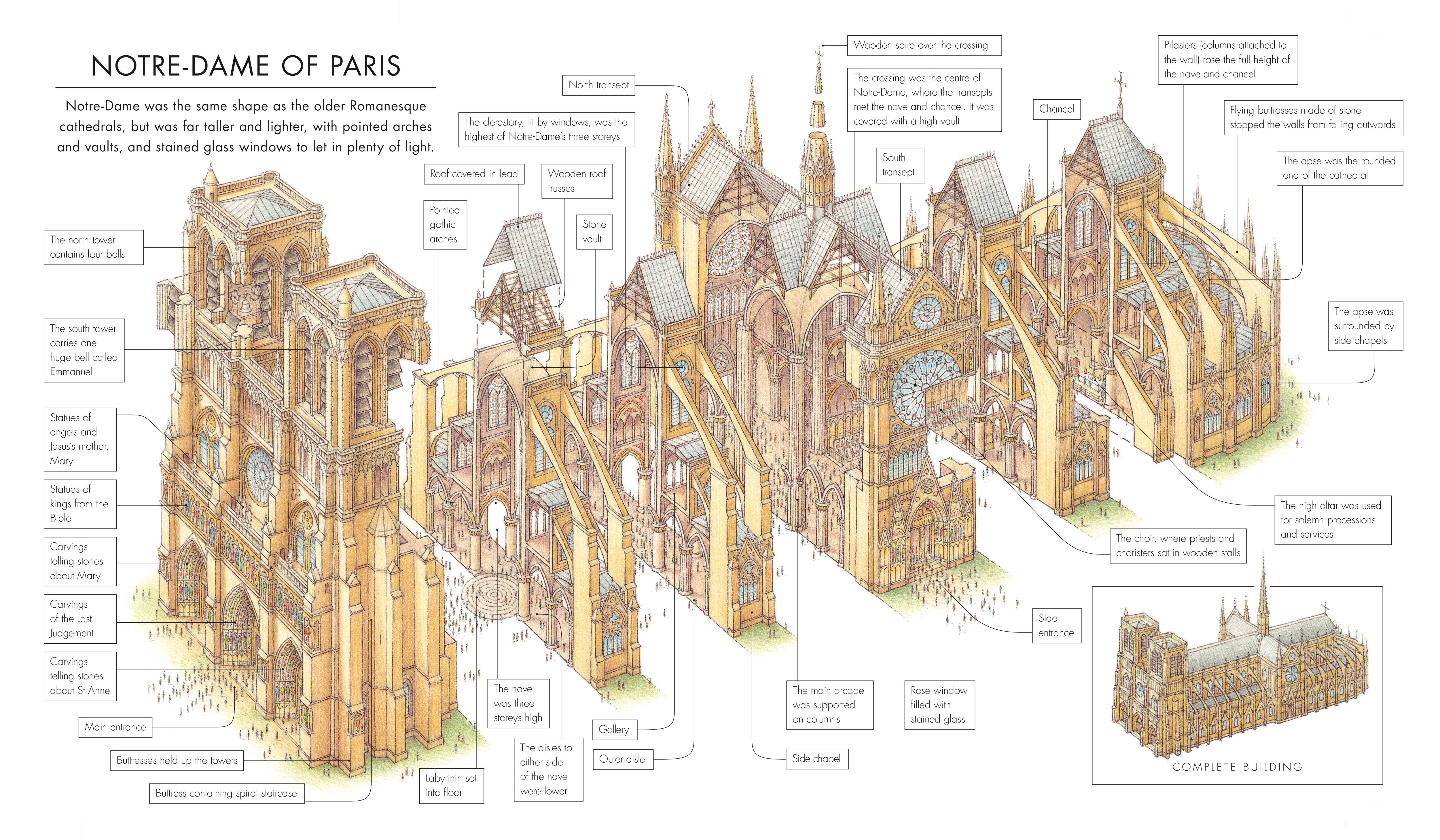

I am very unhappy that Notre Dame burnt. Having said that, I don't see it as "oh no, history has been destroyed" but rather as "this is the history of the Cathedral". If it's still standing (and it seems like it will be), people will talk about this fire for hundreds of years, the same way we talk today about how it survived the French revolution.
Douglas Adams has a great quote on how a building its more than its materials, which you can read in [1]. If we use 3D scans and modern technology to reconstruct the Cathedral to the way it was, I wouldn't see it as "Disneyland" (as the article puts it) but rather as an example of how far we have come and what we can do when we put our minds to it, and how the story of our civilization is written not by design, but rather by accident.
[1] https://www.goodreads.com/quotes/742883-i-remembered-once-in...